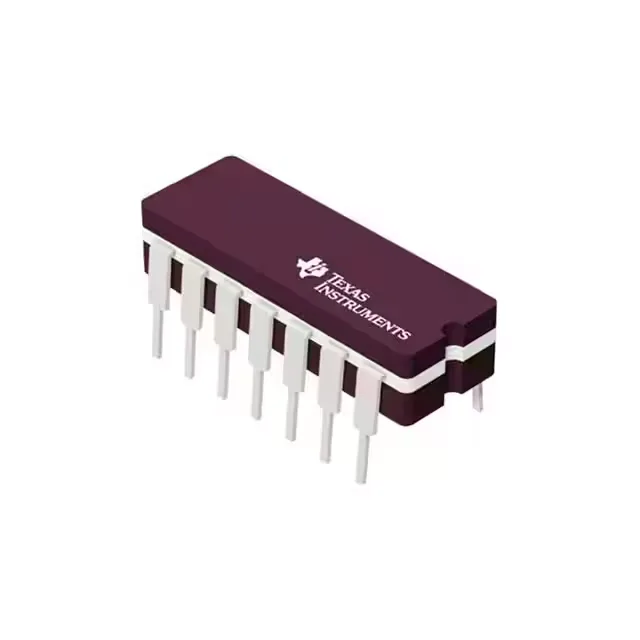
Open-collector inverter — what the 8 mA sink rating means for your bus
The SN74LS05N packs six independent inverter gates, each with an open-collector output — the output transistor's collector is left unconnected internally, so the pull-up resistor and pull-up voltage are your choice. This lets you wire-AND multiple outputs onto a single line or drive loads at a higher voltage than the 5V supply rail, up to the transistor's breakdown limit. Each output sinks 8 mA when low (the 'Low' current in the -, 8mA spec). That 8 mA drives a standard TTL input, an LED, or a small relay directly. For a bus application, the pull-up resistor value sets the rise time; with 32 ns propagation delay at 5V and 15 pF load, this part keeps up with 5V logic at moderate clock rates — think address decoding, status latching, or level translation to 12V or 24V systems.
5V TTL supply and logic thresholds — a 5V-only part for legacy or mixed-voltage boards
Supply range is 4.75V to 5.25V, the classic 5V TTL window. Input low threshold is 0.8V max, input high is 2V min — these are the standard 74LS levels, compatible with 5V CMOS and most 3.3V logic if the 3.3V output high exceeds 2V (which it typically does).
Through-hole DIP — breadboard, prototype, or legacy PCB rework
Housed in a 14-pin DIP with 0.300-inch (7.62 mm) row spacing, the SN74LS05N is a through-hole part — it plugs into breadboards, prototyping boards, and sockets on legacy PCBs. The supplier device package is 14-PDIP. No fine-pitch soldering needed; a standard IC socket or wave-solder process handles it.
Active production and compliance — no last-time-buy to chase
It is ROHS3 compliant (lead-free, no exempt substances).