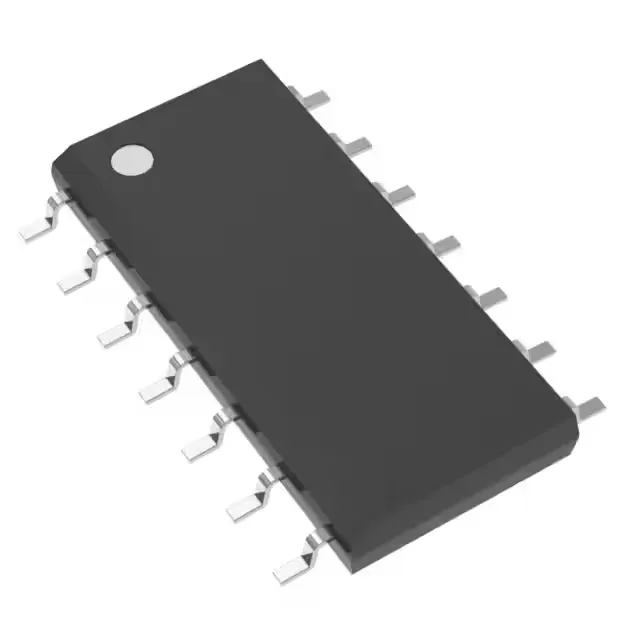
The Texas Instruments SN74HCT14DR is a hex Schmitt-trigger inverter in the 74HCT logic family. It contains six independent inverters, each with a Schmitt-trigger input that provides hysteresis for clean switching on slowly changing or noisy signals. Typical applications include signal conditioning, debouncing switch inputs, squaring up oscillator waveforms, and general-purpose logic inversion in industrial control, telecom, and consumer equipment where noise immunity matters.
Supply voltage and logic-level compatibility
Input logic levels are specified at 0.5 V to 0.6 V for low and 1.9 V to 2.1 V for high, which are compatible with standard TTL thresholds. This means the SN74HCT14DR can directly interface with legacy 5 V TTL outputs and with 3.3 V CMOS outputs that swing above 2.1 V, provided the 3.3 V device's VOH meets the high-level requirement. The Schmitt-trigger hysteresis (typically 0.4 V to 0.6 V) rejects noise on long traces or from inductive coupling in motor-drive environments.
Timing and output drive
Maximum propagation delay is 30 ns at 5.5 V with a 50 pF load. This is adequate for most 5 V logic paths running at clock rates up to about 10 MHz; for faster edges the 74HCS series (e.g., SN74HCS04PWR) offers 16 ns at 6 V. For heavier loads like relay coils or long backplane lines, buffer with a discrete transistor or a higher-drive logic family.
The 14-SOIC package (3.90 mm width,) is a standard surface-mount footprint that reflows well on standard FR-4 with a 0.65 mm pitch. No special moisture sensitivity level is stated, but as a plastic SOIC it is typically MSL 1 or 2 — verify the reel label for bake requirements if the sealed bag has been opened.
For dual-sourcing resilience, the SN74HCS04PWR (74HCS series) offers a pin-compatible Schmitt-trigger inverter with lower propagation delay and a wider 2 V to 6 V supply range, though it is not a direct electrical replacement due to different input thresholds.