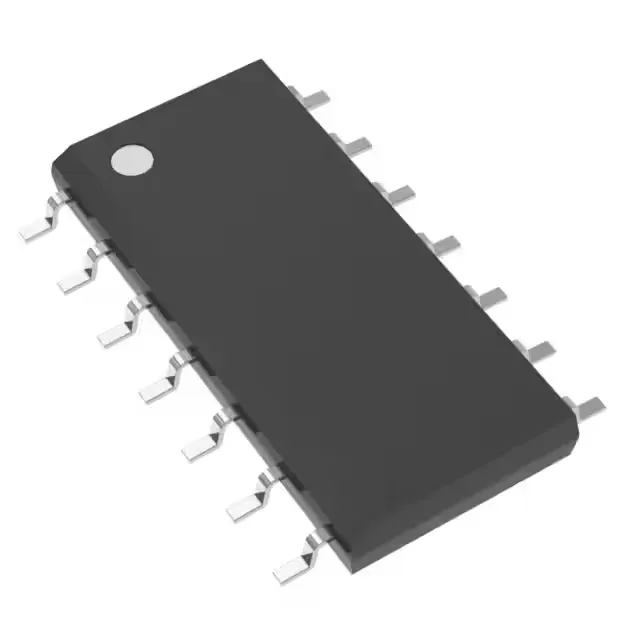
Quad 2-input XOR gate with Schmitt-trigger inputs
It combines the familiar XOR function — output high when inputs differ — with built-in hysteresis that cleans up slow or noisy edges, making it a drop-in upgrade for systems that struggle with the standard 74HC86's input thresholds under noisy supply or long traces. Each of the four independent gates drives up to 7.8 mA at the output, and the device operates across a 2V to 6V supply range, covering 3.3V and 5V rails without a level translator. Temperature range spans -40°C to 125°C, suited for industrial motor drives, automotive body controllers, and outdoor telecom line cards that see thermal cycling.
Schmitt-trigger hysteresis — what it buys you
The Schmitt-trigger inputs define the 74HCS series versus the standard 74HC family. On a conventional HC gate, a slowly rising input — from a capacitor-coupled sensor, a long PCB trace, or a debounced switch — can sit in the linear region long enough to cause oscillation or double-clocking. The SN74HCS86DR's hysteresis (1V to 3V low-level threshold, 1.5V to 4.2V high-level threshold at 5V) provides a clean snap-action transition. In a 5V system, that means a rise time that would glitch an HC86 passes cleanly through the HCS gate. The propagation delay is 12ns at 6V with a 50pF load, comparable to the HC86, so speed is not sacrificed for the noise margin.
There is no last-time-buy notice, and the part is not marked NRND. ROHS3 compliance is confirmed, and the standard ordering codes (Tape & Reel, Cut Tape) are available through normal distribution.