That makes it a straightforward choice for both prototype builds and production runs without scrambling for a drop-in replacement mid-cycle.
Cold-crank at -40°C and hot-soak at 125°C are both inside the guaranteed window, so no parametric derating is needed for those corners.
Schmitt-trigger inputs — why they matter for 5V and 3.3V buses
Schmitt-trigger inputs give this buffer built-in hysteresis, which cleans up slow edges and noisy signals on long PCB traces or cable runs. At 5V supply the switching thresholds sit well within standard TTL and CMOS levels, so it works as a drop-in for 5V logic systems without external conditioning. The same applies at 3.3V — the hysteresis absorbs the ringing from a poorly terminated bus.
Wettable-flank QFN — a rework-friendly package
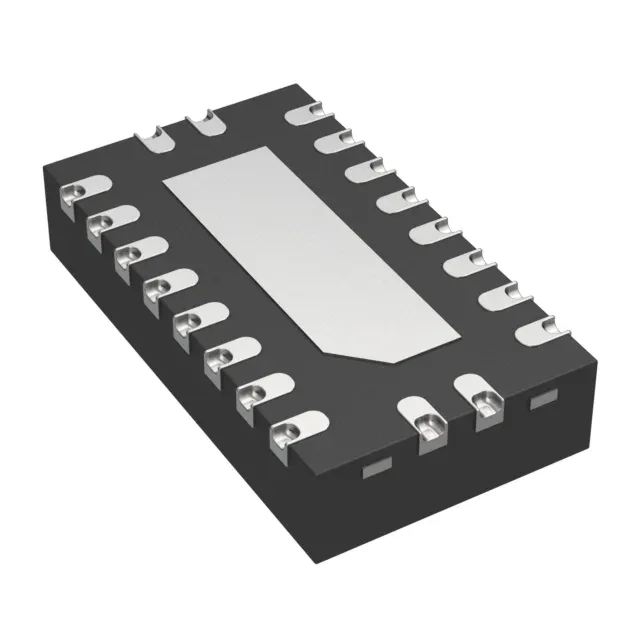
The 20-VFQFN with wettable flank (2.5x4.5 mm body) is one of the more technician-friendly QFN packages. The exposed side pads give a visible solder fillet after reflow, so you can optically inspect the joint instead of relying on X-ray. Under the hot-air station the wettable flank wets out cleanly — lift the part, not the pad.
Supply range 2V to 6V — one part for mixed-voltage boards
The 2V to 6V supply range covers 3.3V and 5V rails without a separate level-shifter. On a mixed-voltage board you can run the buffer from the same 3.3V or 5V rail as the downstream logic, and the Schmitt-trigger inputs tolerate the slower edges from an upstream 3.3V microcontroller driving a 5V peripheral. The 7.8 mA symmetric output drive is enough for a few CMOS loads or a short backplane trace.