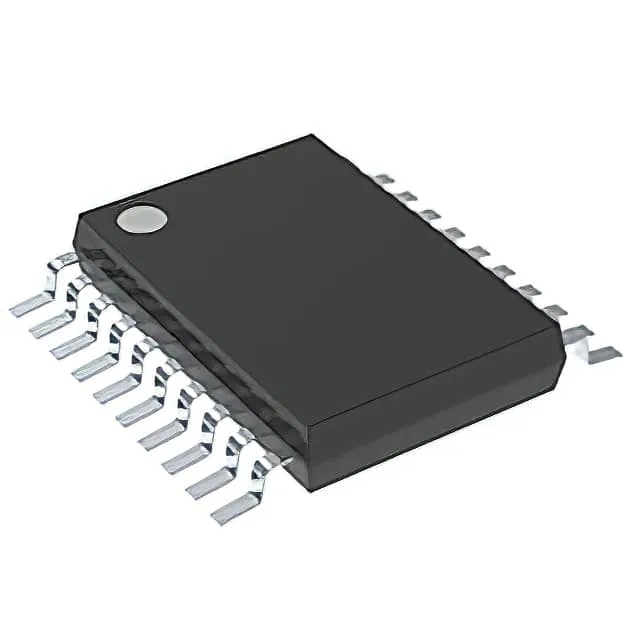
8-bit inverting bus transceiver for 2V–6V rails
The inverting logic means data on the A bus appears inverted on the B bus, which is useful for polarity inversion in control signals or for matching a legacy bus protocol that expects inverted data.
Supply range and logic-level compatibility
At 3.3V VCC, the HC family's input thresholds (typically 0.7×VCC for VIH, 0.3×VCC for VIL) are compatible with 3.3V logic outputs from a Cortex-M or FPGA. At 5V, it interfaces directly with legacy 5V TTL or CMOS peripherals. The 7.8mA output drive per pin (both high and low) is typical for 74HC — enough to drive a handful of CMOS inputs or a low-current LED, but not a high-fan-out bus like a backplane. For a 32mA drive variant, the 74ABT2245 non-inverting transceiver is a different tier.
The 20-TSSOP package (4.40mm body width) saves board area compared to a 20-SOIC, but the fine pitch (0.65mm) means the PCB fab needs a 0.3mm trace/space capability for routing.
No LTB risk for ongoing production. The 74HC series is a mature logic family with broad second-sourcing (TI, Nexperia, ON Semiconductor all make 74HC640 variants), so supply continuity is strong. For a dual-sourcing strategy, any 74HC640 in a 20-TSSOP package from a major vendor is a drop-in substitute — verify the pin 1 orientation mark, but the JEDEC standard footprint is identical.