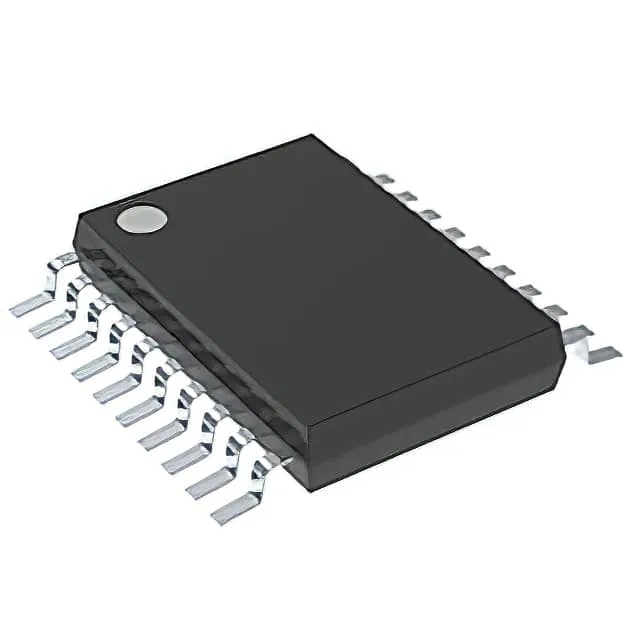
Octal buffer with 3-state outputs for 2V to 6V buses
The Texas Instruments SN74HC541PW is an octal (8-bit) non-inverting buffer with 3-state outputs from the 74HC family. It operates across a 2V to 6V supply range, making it a direct fit for both 3.3V and 5V logic domains without level translation. The symmetric 7.8mA source and sink drive at each output handles typical CMOS fan-out to eight loads, and the 3-state control lets you isolate the bus during power sequencing or multi-master arbitration. The 20-TSSOP package (4.40mm body width) suits space-constrained boards in industrial control, motor drives, and outdoor telecom equipment where the -40°C to 85°C temperature grade is required.
Supply voltage and logic-level compatibility
The 2V to 6V supply range is the defining spec for this buffer. At 3.3V ±10% it meets the VIH/VIL thresholds of a standard 3.3V CMOS bus; at 5V ±10% it interfaces directly with 5V TTL or CMOS logic. There is no separate VCCIO pin — the single supply rail sets both the input thresholds and the output swing. If your design runs a mixed 3.3V/5V backplane, this part bridges the gap without an external translator, as long as the input signals stay within the supply rails.
Output drive and bus isolation
Each of the eight outputs can source or sink 7.8mA. That is enough to drive a standard CMOS load or a short PCB trace, but not a cable or a high-current LED — keep the per-pin current within the 7.8mA ceiling. The 3-state output enable (active-low, shared across all bits) lets you float the outputs when the buffer is not selected, which is essential for shared data buses where multiple devices drive the same lines. The non-inverting path means the output follows the input polarity, so no logic inversion surprises in the signal chain.
The 20-TSSOP package (4.40mm body width, 0.65mm pin pitch) is a common footprint shared with many 20-pin logic devices from TI and other vendors. It is surface-mount only — no through-hole variant exists for this order code. Standard MSL 1 handling applies out of the bag.
It is ROHS3 compliant.