What this octal inverting buffer does on your board
It takes a logic-level input and outputs the inverted version, with each of the two elements handling four bits. The 3-state outputs let you disconnect the buffer from the bus by pulling the output-enable pins high — essential for shared data lines where multiple drivers need to take turns. Supply range of 2V to 6V means it works in both 3.3V and 5V systems without a level shifter, though the 7.8mA output drive is modest: fine for driving CMOS logic inputs or a few LED indicators, but not for relays or long cables directly.
Supply voltage — 3.3V and 5V both work
Rated 2V to 6V, the SN74HC240DBR runs happily on a 3.3V rail or a 5V rail. At 3.3V the propagation delay is a bit longer than at 5V, but for most bus-buffering and signal-inversion tasks the margin is fine. If your design lives at 1.8V, this part won't work — the 74HC family doesn't guarantee operation below 2V. For 1.8V logic, look at the 74LVC or 74AUC families instead.
Package and footprint — 20-SSOP
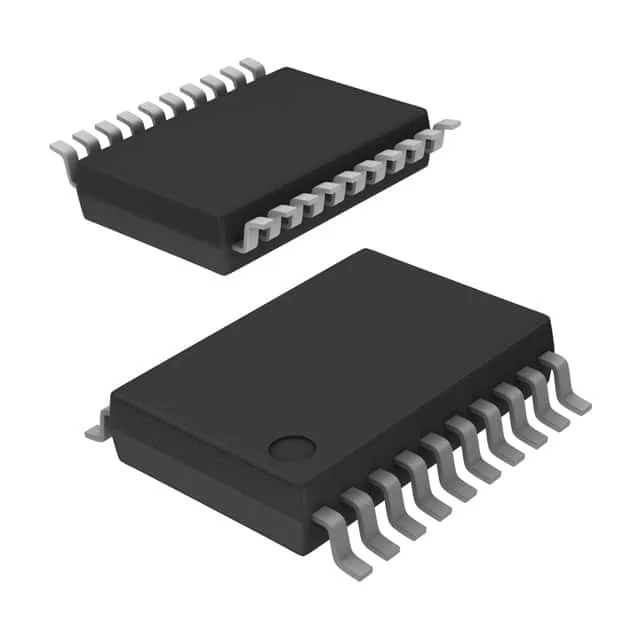
Housed in a 20-SSOP package (0.209" body width, 5.30mm), the SN74HC240DBR is a surface-mount part with a 0.65mm pin pitch.
Temperature grade — industrial, not automotive
It is not qualified to AEC-Q100, so it is not the right choice for under-hood automotive or other high-temperature environments that push beyond 85°C. For those, you would need a 74HC part from the automotive-grade line (typically with a 'Q1' suffix).
For a production BOM, this part is a low-risk choice — no imminent obsolescence to plan around.