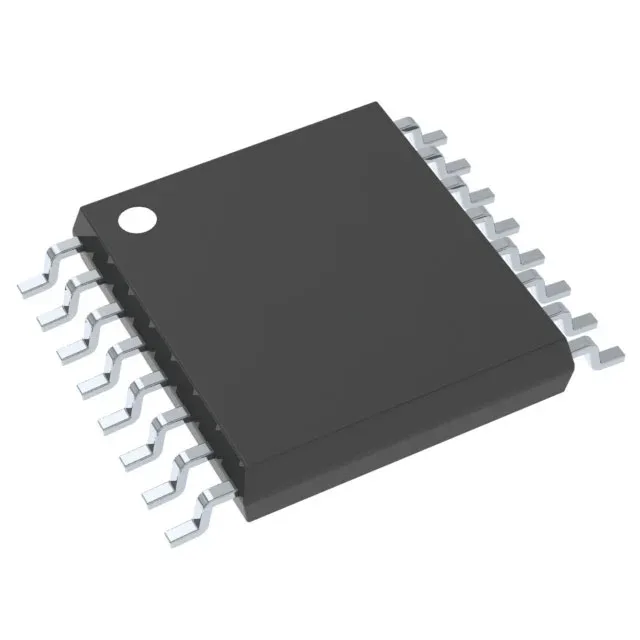
The Texas Instruments SN74HC175PW is a 4-bit D-type flip-flop from the 74HC family, featuring a master reset function and complementary outputs. It is a positive-edge-triggered register that captures the D input on each rising clock edge and presents both Q and Q-bar outputs. This part is used in general-purpose storage registers, data synchronization, and state-machine applications across industrial control, consumer electronics, and telecom equipment, where its 2V–6V supply range allows direct interfacing with both 3.3V and 5V logic domains.
The 60 MHz maximum clock frequency sets the upper speed limit for synchronous designs using this flip-flop. In practice, the propagation delay of 26 ns at 6V supply with a 50 pF load determines how much time is available for signal settling before the next clock edge. For a 60 MHz clock (16.7 ns period), the delay consumes most of the cycle, so this part is better suited to slower clock domains or as a control register rather than a high-speed pipeline stage. At 2V supply the delay will be longer — budget extra margin if running near the low end of the voltage range.
Supply voltage and 3.3V logic compatibility
The 2V to 6V supply range makes the SN74HC175PW directly compatible with 3.3V and 5V logic families. At 3.3V, input thresholds are CMOS-typical (0.3×VCC low, 0.7×VCC high), so a 3.3V microcontroller output drives it cleanly without level translation. Quiescent current is only 8 µA, keeping the static power contribution negligible in mixed-voltage designs.
Package and temperature grade — board-fit decisions
Housed in a 16-TSSOP package with a 0.173-inch body width and 4.40 mm height, this is a surface-mount part suited for compact PCB layouts. Output drive capability is 5.2 mA for both high and low states, adequate for driving logic inputs on a bus or small LEDs, but not for high-current loads like relays.
It is ROHS3 compliant. The 74HC family is widely second-sourced; if dual-sourcing is needed, many vendors offer pin-compatible 74HC175 variants in the same TSSOP-16 footprint.