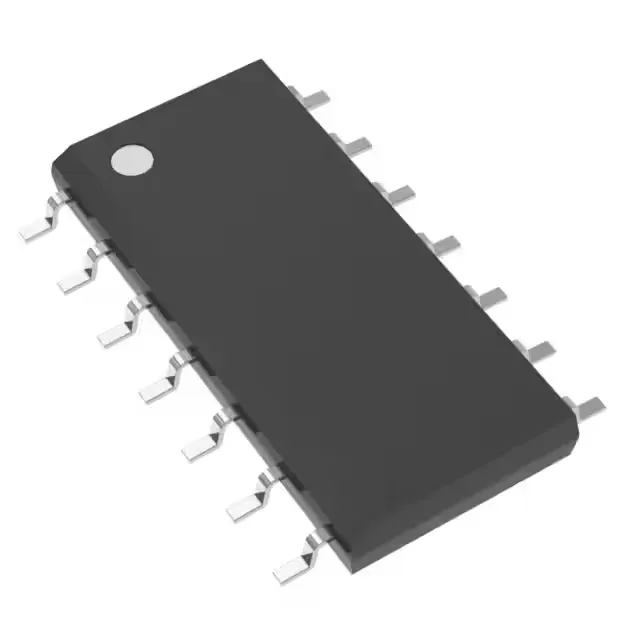
Texas Instruments SN74HC164D — Logic ICs

SN74HC164D Shift Register, 8-Bit Serial to Parallel, 14-SOIC

MPNSN74HC164D
End of Life

Texas Instruments 74HC SN74HC164D, 8-bit serial-to-parallel shift register, push-pull output, 2V to 6V supply, -40°C to 125°C, 14-SOIC surface-mount package.

$1.16Ref. price · indicative, final on quote
Packaging14-SOIC (0.154", 3.90mm Width)
RoHSROHS3 Compliant
Series74HC
Independent supplier — new & surplus stockAuthenticity-screened · ESD-safe packingListing updated Aug 2026

Specifications

SN74HC164D specifications
ParameterValue
Series74HC
Logic typeShift Register
Output typePush-Pull
MountingSurface Mount
Supply voltage2V ~ 6V
Operating temperature-40°C ~ 125°C
PackageTube
FunctionSerial to Parallel
Case14-SOIC (0.154\", 3.90mm Width)
Number of elements1
Number of bits per element8

Product details

8-bit serial-to-parallel shift register in 14-SOIC

The Texas Instruments SN74HC164D is a single-element 8-bit serial-to-parallel shift register from the 74HC logic family, housed in a 14-SOIC surface-mount package. It accepts serial data on two inputs (one can be tied high as an enable) and presents the parallel data on eight push-pull outputs after each clock cycle. The push-pull output stage drives standard CMOS or TTL loads without external pull-ups, simplifying the board layout for LED banks, relay drivers, or parallel bus expansion.

Supply rail and temperature coverage

Rated for 2V to 6V, this shift register works directly on 3.3V or 5V busses without a level translator. The 125°C ceiling matches the junction temperature seen in engine-bay electronics or near hot power stages. If your BOM runs at 1.8V logic, look at the 74LVC family instead; for pure 5V systems this part is a drop-in.

Cascading for longer shift registers

The serial output (Q7) feeds the data input of the next SN74HC164D, so you can chain devices to build a 16-bit, 24-bit, or longer shift register. Each additional stage adds one 14-SOIC footprint and the same supply connection. The clock and clear lines are common across the chain. This is the standard method for driving a matrix of LEDs or reading a bank of switches with minimal GPIO.

There is no last-time-buy risk for new designs. The part is ROHS3 compliant.

Frequently asked questions

Can SN74HC164D be cascaded for more bits?

Yes, the SN74HC164D can be cascaded to create longer shift registers. The serial output of one device feeds the data input of the next, with common clock and clear lines. This allows chaining for 16-bit, 24-bit, or larger shift registers using a single GPIO clock and data line.

What is the difference between SN74HC164D and SN74HC165D?

The SN74HC164D is a serial-in, parallel-out (SIPO) shift register, while the SN74HC165D is a parallel-in, serial-out (PISO) shift register. The 164 loads data serially and presents it on eight parallel outputs; the 165 loads eight parallel inputs and shifts them out serially. They serve opposite data direction roles and are not pin-compatible substitutes.