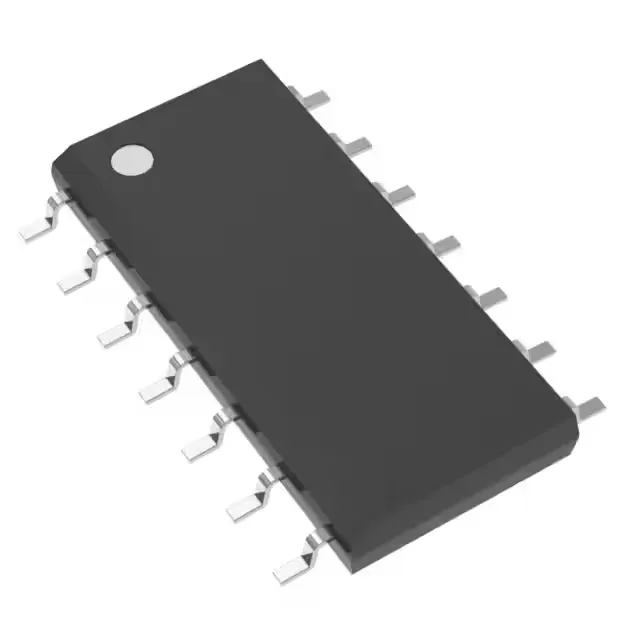
Six inverters in a 14-SOIC — what the 16 ns delay buys you
The SN74HC04D packs six independent inverter gates into a 14-SOIC footprint, each with a single input and a standard push-pull output rated for 5.2 mA source and sink. The 16 ns propagation delay at 6 V with a 50 pF load is typical for the 74HC family — fast enough for most board-level inversion, clock buffering, and signal clean-up tasks where you do not need the sub-10 ns edge rates of 74LVC or 74AUC. The 2 V to 6 V supply range means it runs comfortably on 3.3 V or 5 V rails without a separate regulator, and the –40°C to 85°C temperature grade covers industrial enclosures and outdoor telecom cabinets.
Supply voltage and logic thresholds — 5 V compatibility is built in
With a supply range of 2 V to 6 V, the SN74HC04D accepts a 5 V rail directly. The input logic-low threshold sits between 0.5 V and 1.8 V, and the logic-high threshold between 1.5 V and 4.2 V, so a standard 5 V CMOS or TTL output drives it without level translation. Quiescent current maxes out at 2 µA, making it a low-overhead addition to a mixed-voltage board.
The 14-SOIC package is a standard, widely second-sourced footprint — if you ever need to dual-source, the 74HC04 function is available from multiple manufacturers in the same SOIC-14 land pattern.
Closest functional second source — SN74HCS04PWR
The SN74HCS04PWR is the nearest functional sibling: same six inverters, same 16 ns propagation delay at 6 V/50 pF, same supply range. The key difference is that the HCS variant adds Schmitt-trigger inputs, which provide hysteresis for noise rejection on slowly changing or noisy signals. If your design does not need the Schmitt trigger, the HC04D is the lower-cost, drop-in choice. The HCS04 also extends the temperature range to –40°C to 125°C, which matters for under-hood or high-temp industrial environments.