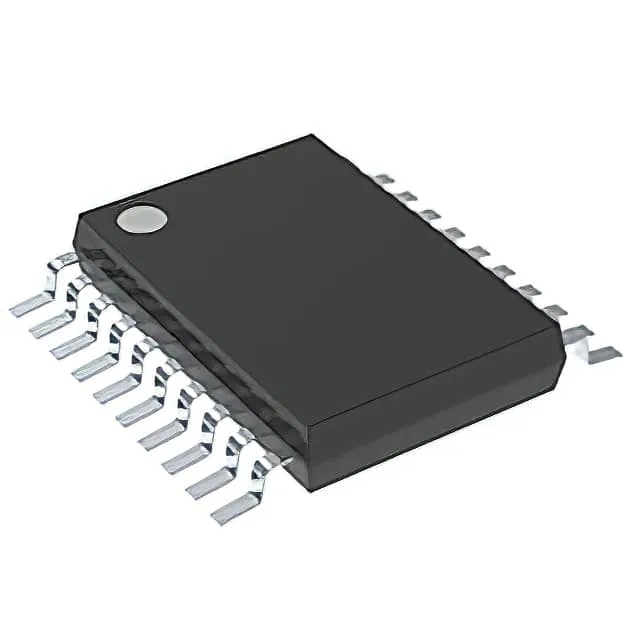
Its job is to connect or isolate two signal paths per channel with minimal propagation delay — essentially a low-ON-resistance pass gate controlled by a single enable pin for each byte. Typical applications include hot-swap isolation, bus sharing between peripherals, and voltage-level translation where the switch's low on-capacitance keeps signal integrity clean up to the device's bandwidth.
Supply rail and temperature — the decision drivers
The single-supply range of 4 V to 5.5 V is the headline constraint. At 5 V nominal the switch delivers its lowest on-resistance and best signal swing; dropping to 4 V still keeps the pass gate fully enhanced for 3.3 V logic inputs, but the design should verify that the output high level meets the downstream receiver's VIH at the minimum supply. No derating is needed for most motor-drive or outdoor applications, but if the ambient regularly exceeds 85°C — say in a sealed enclosure near a heat sink — the designer should check the junction-to-ambient thermal resistance for the TSSOP package to confirm margin. The device is rated for continuous operation across the full temperature band.