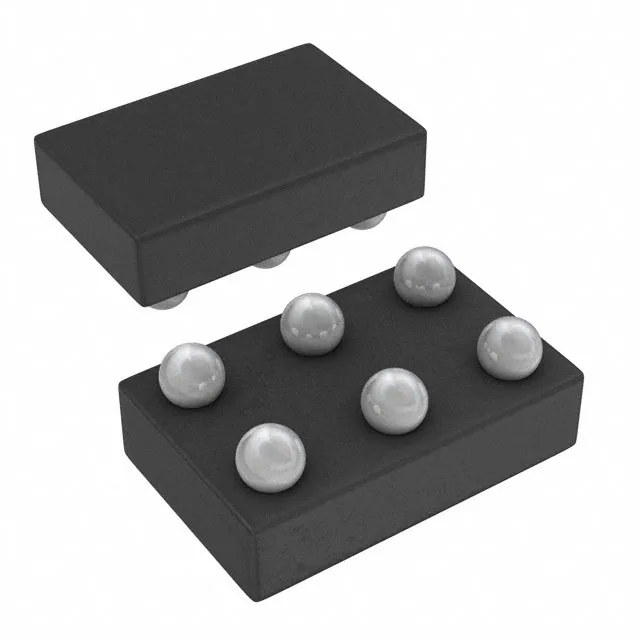
Single inverting buffer for sub-1V rails
It operates from 0.8V to 3.6V, spanning single-cell battery voltages through standard 3.3V logic rails. Output drive is rated 4mA source and 4mA sink at 3.6V supply — enough to drive CMOS logic inputs or a small LED indicator, but not intended for heavy loads.
0.8V to 3.6V supply — what it buys you
The supply range is the headline feature. At 0.8V minimum, this buffer works directly from a near-depleted alkaline cell or a 1.2V NiMH battery without a boost regulator. At 1.8V typical — the most common query for this part — the device is fully specified and drives the rated 4mA output. That saves a voltage translation stage in mixed-voltage designs where a 1.8V MCU talks to a 3.3V peripheral.
DSBGA package — layout and rework realities
No leads to inspect visually — x-ray or cross-section is the only way to verify joint integrity. For rework, the part needs a hot-air profile matching the 0.4mm pitch; a standard hot-air pencil at 350°C can shift adjacent balls if the nozzle is too large. Stencil aperture should be 1:1 with the ball diameter, and the PCB pad finish must be OSP or ENIG — HASL is too uneven for this pitch.
Lifecycle — no LTB risk
The ROHS3 compliance mark is confirmed on the reel label.