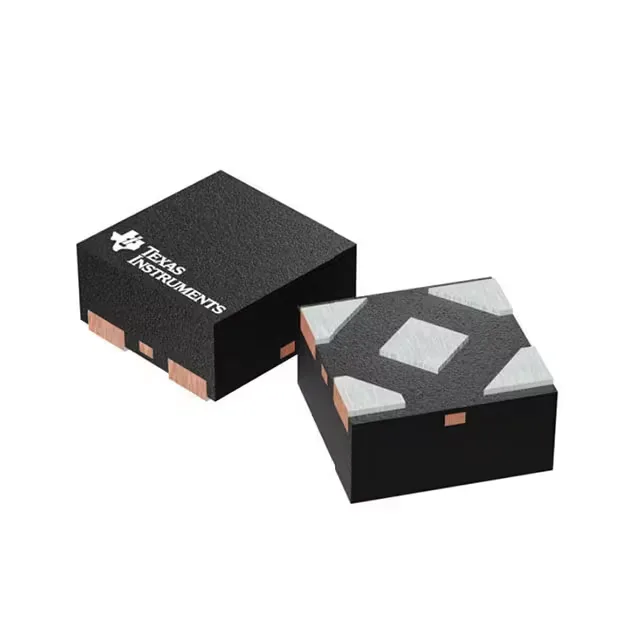
Single inverting buffer for multi-voltage glue logic
The Texas Instruments SN74AUP1G240DPWR is a single-bit inverting buffer with 3-state output, part of the 74AUP ultra-low-power CMOS logic family. Its supply range from 0.8V to 3.6V lets it bridge between 1.8V and 3.3V logic domains without an external level translator — a common need when a 1.8V sensor or MCU GPIO must drive a 3.3V input on an older peripheral. The 3-state output (high, low, high-impedance) allows multiple outputs to share a bus line, making it useful for multiplexed address/data lines or shared interrupt lines in low-power portable designs.
Supply range from 0.8V to 3.6V — the reason you pick this family
The 0.8V to 3.6V supply range is the headline feature of the 74AUP series. Most competing single-gate buffers (e.g., 74LVC or 74AHCT) have a minimum supply around 1.65V or 2.0V. The 74AUP family extends down to 0.8V, which is critical for battery-powered devices running near the end of discharge on a single-cell Li-ion (2.7V to 3.0V nominal) or for designs using sub-1V core voltages. If your system never runs below 1.8V, a 74LVC1G240 would also work and might be cheaper — but for true sub-1V operation, this is the part.
4mA symmetrical output drive — enough for a CMOS load, not for a cable
That is typical for the 74AUP family's ultra-low-power focus: the transistors are sized for minimal leakage, not high current. It will cleanly drive one or two standard CMOS inputs on a PCB trace under a few centimetres, but it will not drive a long backplane trace, a terminated transmission line, or an LED. If you need 24mA or 32mA drive, step up to the 74LVC or 74AHCT families — but expect higher quiescent current.
X2SON-5 package — 0.8mm x 0.8mm footprint
The SN74AUP1G240DPWR comes in a 5-pin X2SON package measuring 0.8mm x 0.8mm (supplier device package 5-X2SON). This is an extremely small package — roughly the size of a grain of pepper. It is ideal for space-constrained designs like wearables, sensor modules, or mobile devices where every square millimetre counts. The trade-off is that hand-soldering is impractical; it requires a stencil, reflow oven, and preferably automated optical inspection.
It does not cover automotive under-hood environments (which typically require -40°C to 125°C) or extended industrial applications near ovens or engines. For those, look at the automotive-qualified 74AUP1G240Q series.
It is not nearing end-of-life, not in last-time-buy, and not subject to a PCN for discontinuation.