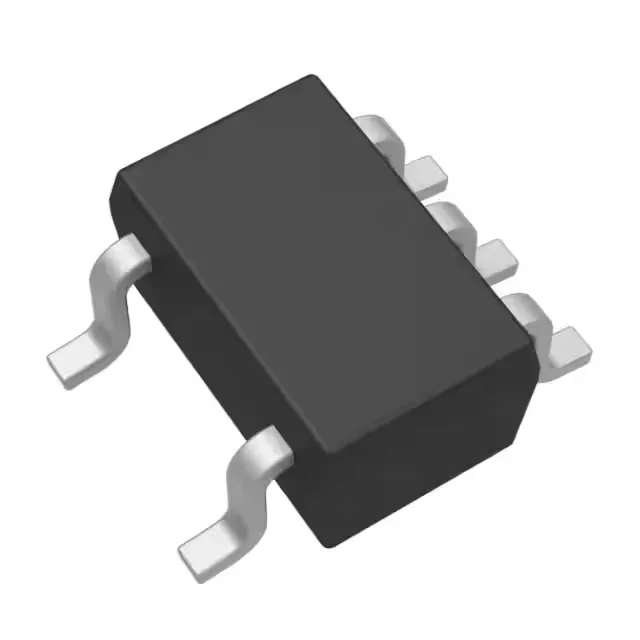
What this single-gate inverting buffer does on your board
The Texas Instruments SN74AUP1G240DCKR is a single inverting buffer with a 3-state output from the 74AUP series — the ultra-low-voltage logic family designed for battery-powered and portable gear where every microamp matters. It takes one logic input and drives its inverted version onto a shared bus when the output enable is active, or goes high-impedance to let another device take the line. The 0.8V to 3.6V supply range means it plays nicely with sub-1V cores and legacy 3.3V peripherals alike, without needing a separate level translator in many cases.
Supply range — the real differentiator in the 74AUP family
The 0.8V to 3.6V operating supply is the headline feature here. Older logic families like the 74ABT (4.5V minimum, as in the SN74ABT2245DW) or even the 74LVTH (2.7V minimum) can't touch this part's ability to run from a single Li-ion cell near end-of-discharge or from a 1.2V core rail. The 74AUP series is built for that low-voltage regime, with propagation delays and output drive characterized down to 0.8V — something a standard 3.3V buffer simply won't guarantee.
It is not AEC-Q100 qualified like the SN74LVC2G17QDCKRQ1 (which extends to 125°C), so it's not the pick for under-hood automotive or engine-bay applications. For factory-floor sensors, handheld instruments, or IoT edge nodes, the temperature range is adequate.
The SC-70-5 (also known as SOT-353) is a 5-pin package with 0.65 mm pitch. It's small enough to fit on a cramped sensor board but a pain to hand-solder without a fine tip and magnification. If you're repairing a board that has this part and the scorch mark tells you it failed, be ready with a hot-air station and some flux — tweezers and a standard iron will fight you.
Lifecycle — no surprises here
No end-of-life notice, no last-time-buy pressure.