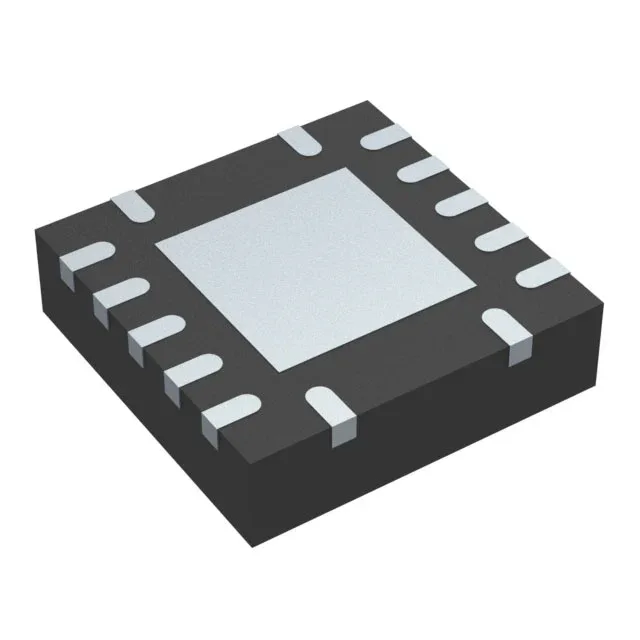
Six non-inverting buffers for sub-2.7V logic rails
The Texas Instruments SN74AUC34RGYR is a hex non-inverting buffer from the 74AUC series, designed for ultra-low-voltage operation from 0.8V to 2.7V. Each of its six independent buffers handles one bit, with push-pull outputs capable of sourcing or sinking 9mA. This part lives in the space between core-voltage logic and I/O translation — think 1.2V or 1.8V FPGA banks, low-power MCU GPIO expansion, or level-shifting between sub-2V domains where a standard 3.3V 74LVC part would overstress the input.
Supply voltage — the 74AUC differentiator
The 0.8V to 2.7V supply range is the headline spec. Most 74-series logic families (LVC, LVTH, ABT) bottom out at 1.65V or 2.7V; the 74AUC family extends down to 0.8V, making it one of the few off-the-shelf buffers that can interface directly with sub-1V cores without an external level translator. At the top end, 2.7V means this part cannot be used on a 3.3V rail — that is a common BOM trap. If your design runs at 3.3V or 5V, you need a 74LVC or 74AHCT part instead.
Package and footprint — 14-VQFN with exposed pad
Housed in a 14-VFQFN with an exposed thermal pad, the SN74AUC34RGYR measures 3.5x3.5mm (supplier device package 14-VQFN).
It covers factory-floor electronics, outdoor telecom cabinets, and commercial HVAC controls, but not automotive under-hood or extended-temperature (125°C) applications. For those, look at the 74AUC-automotive-grade variants if they exist, or step up to 74LVC with AEC-Q100 qualification.
Output drive — 9mA per channel, push-pull
That is enough to drive a few CMOS gate inputs, a low-power LED indicator, or a short PCB trace, but not a long backplane line or a high-fan-out clock tree. If you need more drive, a 74LVC part at 3.3V would offer 24mA or 32mA per output — but at the cost of a higher supply voltage.