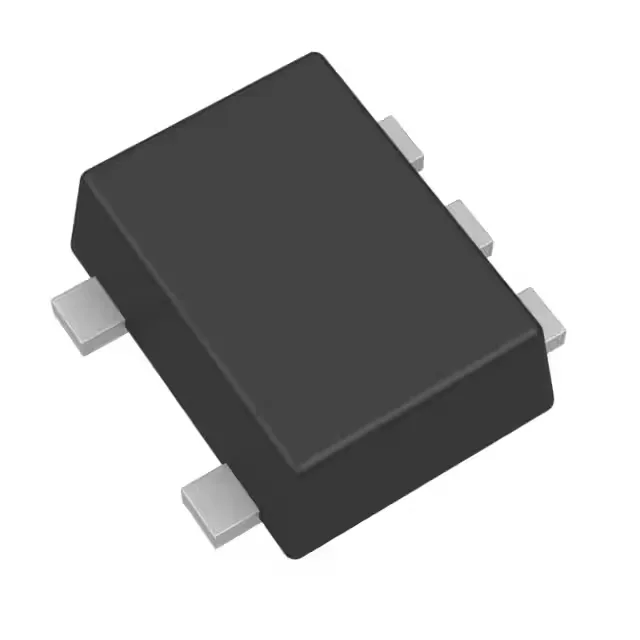
It delivers push-pull output with 9mA source and sink capability, packaged in a 5-pin SOT-553. The Schmitt-trigger input provides hysteresis for noise-tolerant signal conditioning on slow or noisy edges, making it suitable for level translation, clock buffering, and sensor interface in battery-powered portable devices, IoT nodes, and low-voltage industrial control logic where the supply rail stays under 2.7V.
Supply voltage — the hard constraint
The 0.8V to 2.7V supply range is the defining spec for this buffer. It will not operate at 3.3V or 5V — the absolute maximum is 2.7V. If your design runs on a 1.8V or 2.5V rail, this part fits directly. For 3.3V systems, you need a different logic family such as the 74LVC or 74AHC series.
Industrial temperature and small footprint
The SOT-553 package measures roughly 1.6 mm x 1.6 mm, saving board space in dense layouts.
No direct second-source alternate is listed, but the 74AUC series is a standard TI logic family with broad distributor stocking.