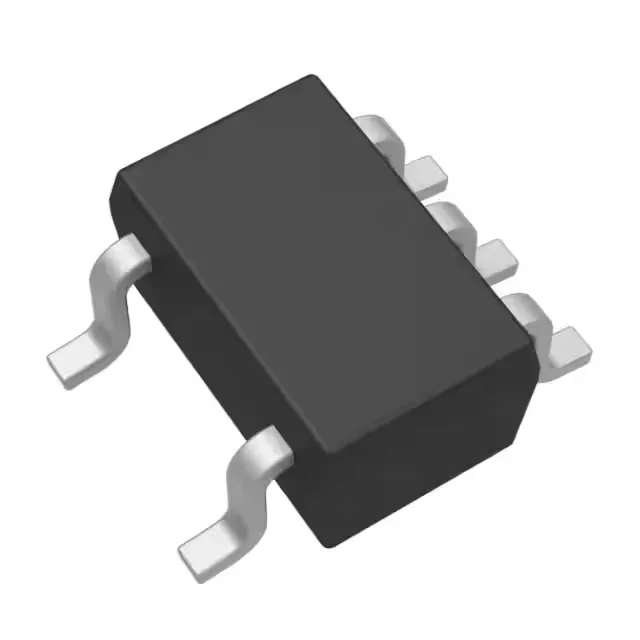
Texas Instruments SN74AHCT1G04DCKT — Discrete Semiconductors

SN74AHCT1G04DCKT TI Inverter, SC-70-5, 4.5-5.5V, 8mA

MPNSN74AHCT1G04DCKT
End of Life

Texas Instruments 74AHCT series inverter, SN74AHCT1G04DCKT, single-channel, SC-70-5 package, 4.5V to 5.5V supply, 8mA output drive, 9ns propagation delay, -40°C to 125°C.

$0.97Ref. price · indicative, final on quote
Packaging5-TSSOP, SC-70-5, SOT-353
StockContact for availability
Lead timeIn Stock wk
MOQ1 pcs
  • 100% new & originalTraceable channels only — no refurbs, no pulls, no remarked parts.
  • Date & lot codes on quoteStated per line before you commit; label photos on request.
  • MSL-compliant ESD packingMoisture-sealed bags with indicator cards; reels photo-verified.
  • PayPal buyer protectionPay by T/T, PayPal or Payoneer — card payments covered end to end.

Specifications

SN74AHCT1G04DCKT Technical Specifications
ParameterValue
Series74AHCT
Logic typeInverter
Mounting typeSurface Mount
Voltage4.5V ~ 5.5V
Current - quiescent1 µA
Current - output high, low8mA, 8mA
Number of inputs1
Operating temperature-40°C ~ 125°C
PackageTape & Reel (TR); Cut Tape (CT)
Case5-TSSOP, SC-70-5, SOT-353
Number of circuits1
Input logic level - low0.8V
Input logic level - high2V
Max propagation delay @ v, max CL9ns @ 5V, 50pF

Product details

Single-gate inverter for 5V logic busses

The SN74AHCT1G04DCKT is a single-channel inverter from Texas Instruments' 74AHCT series, designed for 4.5V to 5.5V supply rails. It delivers 8mA source and sink output drive, enough to switch a standard CMOS load or drive a short trace on a mixed-voltage backplane without a buffer. Input logic thresholds are set at 0.8V low and 2V high, making it directly compatible with 5V TTL outputs — no level translation needed at the gate input. The 9ns max propagation delay at 5V into 50pF keeps the signal clean for bus speeds up to about 50 MHz, though the real limit is the output rise time into the load capacitance.

Package, footprint, and temperature range

Housed in a 5-lead SC-70-5 (SOT-353) package, the part occupies roughly 2.0 × 2.1 mm on the board. The 0.65 mm pin pitch fans out easily on a two-layer board — no fine-line routing required. Surface-mount assembly with standard reflow profiles; the package is compatible with both leaded and lead-free solders. Rated for -40°C to 125°C ambient operation, this inverter covers the full industrial temperature band. The quiescent current maxes out at 1 µA, so it won't tax the 5V rail in a power-sensitive design.

Lifecycle and compliance

RoHS3 compliance means it meets the latest EU restriction limits for lead, mercury, cadmium, and other substances. The part is supplied in Tape & Reel or Cut Tape options for pick-and-place assembly.

Sourcing and availability

This TI inverter is sourced through independent distribution channels. Pricing and lead time are confirmed at quote time against the specific BOM quantity. No minimum order quantity restrictions apply for standard reel quantities.

Frequently asked questions

What supply voltage range does the SN74AHCT1G04DCKT require?

It operates from 4.5V to 5.5V, making it a dedicated 5V logic device. The input thresholds are set for TTL compatibility — 0.8V low and 2V high — so it directly interfaces with 5V TTL outputs without external level shifting.

What package does the SN74AHCT1G04DCKT come in?

It is supplied in a 5-lead SC-70-5 (SOT-353) surface-mount package. The 0.65 mm pitch allows easy breakout on standard two-layer PCBs.

What is the output drive capability of this inverter?

It can source and sink 8 mA per output. This is sufficient to drive one standard CMOS load or a short PCB trace; for heavier loads or longer lines, a buffer stage may be needed.

What is the closest functional replacement for the SN74AHCT1G04DCKT?

The SN74LVC2G132DCUR is a dual NAND gate with Schmitt-trigger inputs from the 74LVC family, operating at 1.65V to 5.5V. It is not a pin-for-pin replacement — different logic function, different pinout — but may serve as a functional alternative in 5V designs where Schmitt-trigger hysteresis is acceptable. Verify the board layout and logic function before substituting.