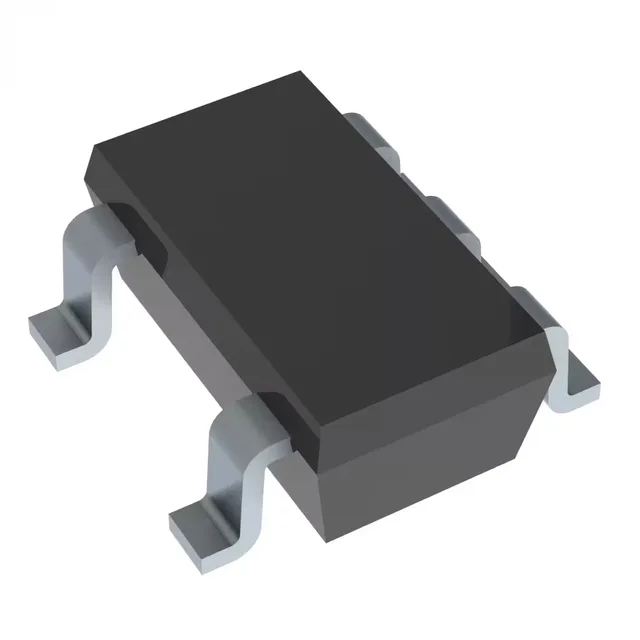
Active single XOR gate with Schmitt-trigger inputs
The SN74AHC1G86DBVR: The Schmitt-trigger inputs provide hysteresis, cleaning up slow or noisy edges — useful when the gate is driven by a mechanical switch, a long PCB trace, or a sensor with a slow rise time. Without that hysteresis, a floating or slowly-rising input could cause the output to oscillate or draw excess shoot-through current.
Supply range and timing — what matters for the BOM
The input logic thresholds scale with VCC: low-level threshold is 0.5V to 1.65V, high-level is 1.5V to 3.85V, so the gate recognizes standard CMOS levels across the full supply range. Maximum propagation delay is 8.8 ns at 5V with a 50 pF load. That is fast enough for control handshaking, clock gating, or data-path correction in most industrial and consumer designs — but not for high-speed memory interfaces or RF switching, where sub-ns gates are needed. Output current is 8 mA source and 8 mA sink. That drives a standard CMOS input directly or switches a small LED with a series resistor. For heavier loads — relays, optocouplers — a buffer or transistor driver is still required.
Temperature grade and package — deployment envelope
It does not carry AEC-Q100 automotive qualification, so it is not specified for under-hood or chassis-mounted applications. The SOT-23-5 (SC-74A) package is a standard five-pin footprint. No exposed pad means the thermal path is through the pins only — keep the ambient temperature within the rated range. Quiescent current is 1 µA maximum, so the gate adds negligible drain in battery-powered or always-on circuits. The ROHS3 compliance means it ships without restricted substances — no exemption paperwork needed for EU-market assembly.