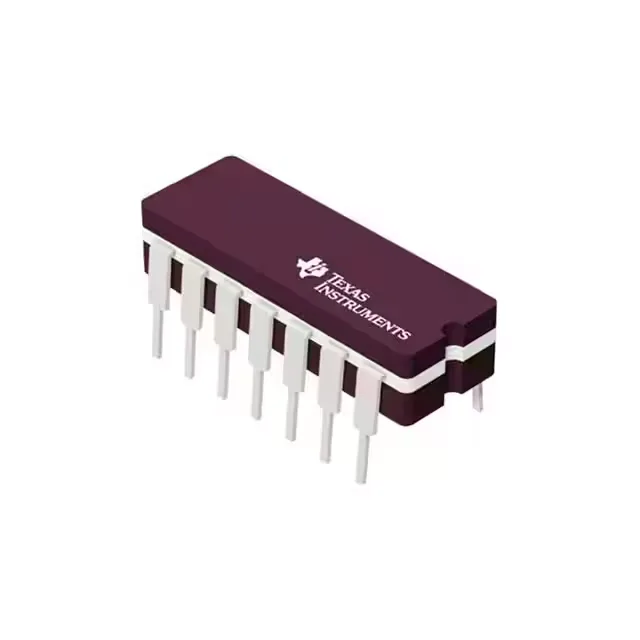
Schmitt-trigger inputs clean up noisy digital lines
The SN74ACT14N packs six independent inverter channels, each with a Schmitt-trigger input that provides hysteresis between the low (0.5V to 1.4V) and high (1.2V to 2.1V) logic thresholds. This hysteresis rejects input noise and slow edges that would cause a standard-gate inverter to oscillate or draw shoot-through current. It is the go-to part when a sensor output, mechanical switch, or long PCB trace delivers a bouncy or slow-rising signal that needs to be squared up for a downstream counter, interrupt pin, or logic array. Each output sources or sinks 24 mA — enough to drive a standard TTL load, an LED indicator through a series resistor, or the input of a second logic family without an extra buffer. The 11.5 ns propagation delay at 5V and 50 pF load keeps the part comfortable in control loops and data paths running at several tens of megahertz; for faster edges, the 74ACT family's bipolar-CMOS output stage delivers the drive without the quiescent penalty of pure bipolar logic.
Through-hole 14-DIP for breadboard and legacy boards
The 14-pin PDIP (0.300" row spacing) is the classic breadboard-friendly package. It mates with standard DIP sockets, wire-wrap posts, and solder-in PCB layouts that have been in production for decades. The through-hole package handles moderate vibration environments better than a fine-pitch SMT part — the leads absorb some board flex before the solder joints crack.
Active production, ROHS3, no second-source on record
The closest functional peers — SN74HCS04PWR, SN74HCS14QDRQ1, and SN74LVU04APWT — all use surface-mount packages (SOIC, TSSOP, etc.) and operate from 2V supplies. They are not pin-compatible with the SN74ACT14N's 14-DIP footprint and 5V-only rail. A board designed around the through-hole PDIP cannot drop in an SMT peer without a layout change.