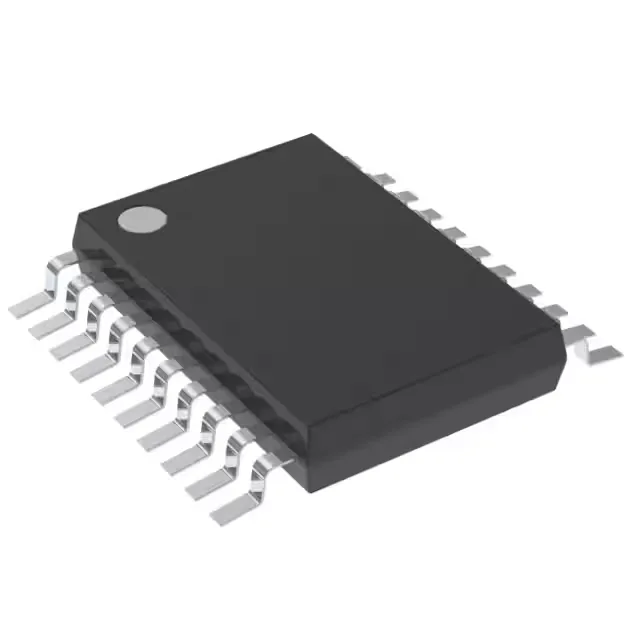
Dual 4-bit buffer for 5V bus interfaces
It is designed for driving heavily loaded backplanes or memory-address buses in 5V systems, where its 32 mA source and 12 mA sink capability provide the fan-out needed for multiple loads without external line drivers. The two independent 4-bit sections let you gate separate data paths from a single package, reducing board count on medium-density PCBs.
That is a deliberate fit for legacy telecom line cards, industrial PLC I/O modules, and motor-drive control logic that still runs on a 5 V plane. If your board has already migrated to 3.3 V or lower, this buffer will not work without a level translator — the 74ABT family does not tolerate sub-4.5 V supplies. For a mixed-voltage design, a 74LVC or 74AHC variant would be the correct drop-in, but they trade off the 32 mA drive strength this part delivers.
20-SOIC footprint and industrial temperature grade
Housed in a 20-SOIC package (0.209" body width, 5.30 mm), the SN74ABT2244ANS uses the standard SOIC-20 land pattern — no fine-pitch surprises for the PCB layout engineer.
Output drive and 3-state control
The 32 mA source / 12 mA sink rating is the headline number for bus-interface designs. At 5 V, 32 mA can drive a 50 Ω terminated backplane trace or fan out to eight standard LSTTL loads. The 3-state outputs let multiple buffers share a data bus — the output-enable pins on each 4-bit section allow per-byte bus isolation, which is useful for multiplexed address/data schemes in older 8-bit or 16-bit microcontroller systems. Note the asymmetry: sink current is lower than source, so the falling-edge drive is weaker; factor that into your signal-integrity budget if the trace is long or heavily loaded.
The 74ABT series has been in the TI catalog for decades, and active status suggests the fab line is still running; if a PCN does surface, the standard TI notification window applies.