16-bit buffer with 32 mA / 64 mA drive — bus fan-out headroom
Its headline output drive — 32 mA source, 64 mA sink — gives it the fan-out to drive heavily loaded backplanes or long PCB traces without external line drivers.
64 mA sink — what it buys the backplane
The 64 mA low-level output current is the spec that matters for heavily loaded buses. Each output can sink enough current to drive the characteristic impedance of a typical backplane trace (50–75 Ω) with clean edges, reducing the need for external bus transceivers. At 32 mA source, the high-level drive is still strong enough for most CMOS and TTL inputs, but the asymmetry means the falling edge will be faster than the rising edge — account for that in timing budgets on long lines.
4 × 4 organization — flexible bus-width mapping
Four elements of four bits each gives the designer options: use all four as a single 16-bit buffer, or gate each 4-bit bank independently with separate output-enable controls (the OE pins are per-element). This is useful when splitting a 16-bit data bus into byte lanes that need independent tri-state control, or when driving multiple narrower buses from a single controller port.
Industrial temperature range and 5 V supply
The 5 V supply rail is standard for legacy 74-series logic, but note that the ABT family's bipolar-CMOS process gives it lower propagation delay than pure CMOS 74HC or 74HCT parts at the same voltage.
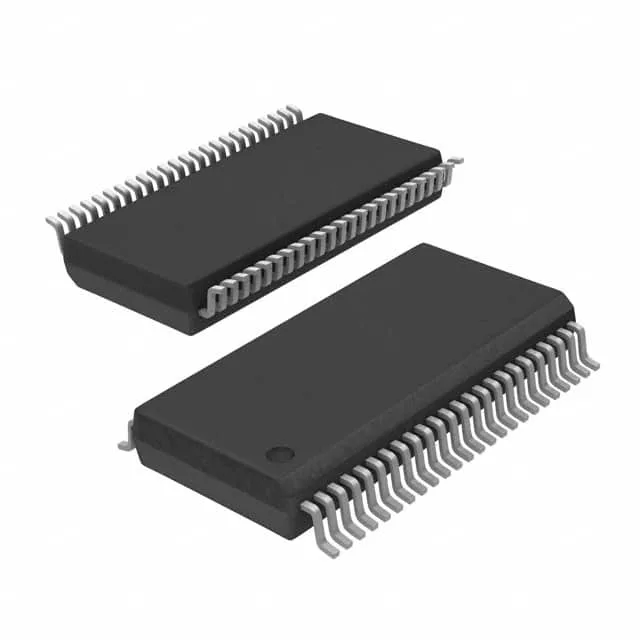
Package and footprint — 48-SSOP
Housed in a 48-SSOP (shrink small-outline package) with 0.635 mm pitch, this is a surface-mount part that routes on standard 2-layer boards without blind vias. The 7.50 mm body width fits the common SSOP-48 land pattern. The tube delivery is typical for production quantities; if you need tape-and-reel for pick-and-place, verify the reel option with your distributor at quote time.
ROHS3 compliant — suitable for EU and global markets where lead-free assembly is mandatory.