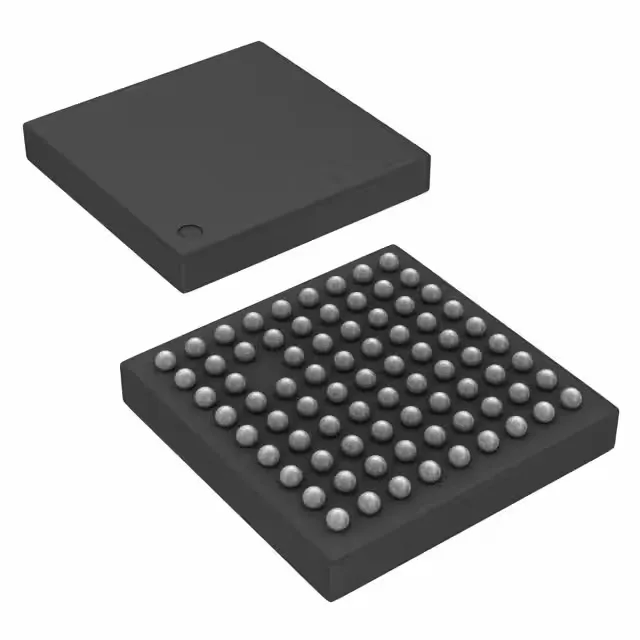
The Texas Instruments SN65LVDS301ZQE is a serializer that takes 24 parallel CMOS inputs and serializes them onto 3 LVDS output pairs, achieving an aggregate data rate of 1.755 Gbps. This part is designed for applications that need to move wide parallel video or data buses over a narrow, high-speed LVDS link—think flat-panel display interfaces, camera modules, or any board-to-board link where reducing cable count and EMI matters. The 24:3 serialization ratio means you can replace a 24-bit parallel bus with just three differential pairs, saving significant board area and connector pins.
At 1.755 Gbps aggregate, each of the three LVDS output lanes runs at roughly 585 Mbps. That's fast enough for 24-bit color depth at WUXGA (1920×1200) refresh rates or for streaming uncompressed video from a high-resolution image sensor. The CMOS input side expects parallel data at a corresponding pixel clock; at full rate the input clock would be near 73 MHz. Signal integrity on the LVDS outputs depends on controlled-impedance traces (100 Ω differential) and keeping the stub lengths short. The 1.65 V to 1.95 V core supply is tight—a 1.8 V rail with ±5% regulation covers it, but a 1.8 V rail that droops below 1.65 V during transient loading will cause the PLL to lose lock.
80-BGA MICROSTAR JUNIOR — package realities
The SN65LVDS301ZQE comes in an 80-ball BGA MICROSTAR JUNIOR package measuring 5 mm × 5 mm. The small footprint is a double-edged sword: it saves board space, but rework is non-trivial. If you're prototyping, plan on X-ray inspection of the BGA joints; a single cold joint on an LVDS lane will kill the link.
That means Texas Instruments has stopped production and there is no scheduled last-time buy window remaining. Every unit we source is inspected for date-code consistency, marking integrity, and lead-free compatibility; given the fine-pitch BGA, we also verify that the balls are not oxidized or reballed. If you need a drop-in replacement, see the FAQ below.