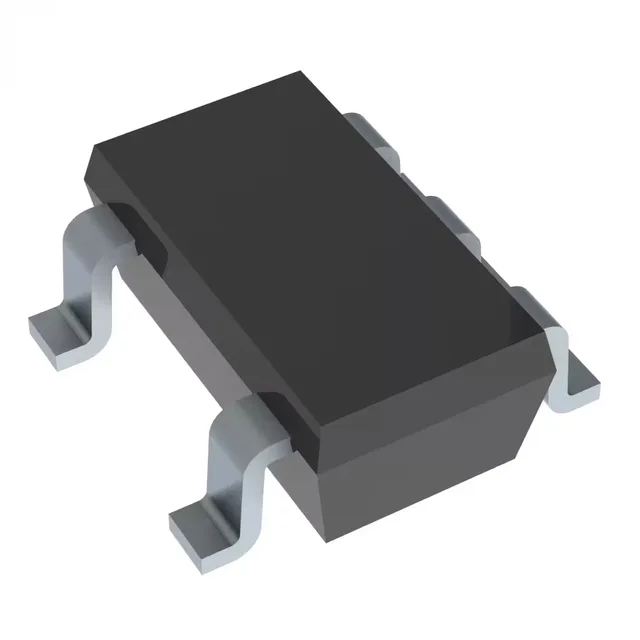
The supply range of 2.4V to 3.6V lets it run from a 3.3V or 2.5V rail without an extra regulator. The SOT-23-5 footprint saves board area on dense mixed-signal PCBs.
400 Mbps and the signal-integrity budget
At 400 Mbps the bit period is 2.5 ns, so the receiver's propagation delay and skew eat into the timing margin. The 65LVDS2 is specified for this rate with a typical differential threshold of ±100 mV, which gives reasonable noise immunity on short PCB traces. If your link runs longer than a few inches or crosses a connector, budget for the cable's attenuation and keep the differential impedance matched to 100 Ω. The receiver's input common-mode range covers 0.2V to 2.2V, so it works with most standard LVDS transmitters.
The 2.4V to 3.6V supply covers both 2.5V and 3.3V logic families. At 3.3V the receiver draws about 10 mA quiescent current — no heavy load on the rail. No automotive-grade rating (AEC-Q100) is listed, so it is not a fit for under-hood or chassis-domain designs without additional screening.
The SOT-23-5 (SC-74A) package is a five-pin small-outline transistor footprint. The part is also available in a cut-tape option (SN65LVDS2DBVT) for prototyping. The small body means the decoupling capacitor should sit as close as possible to the supply pin; a 0.1 µF ceramic in 0402 or 0603 fits alongside the package.
It is ROHS3 compliant.