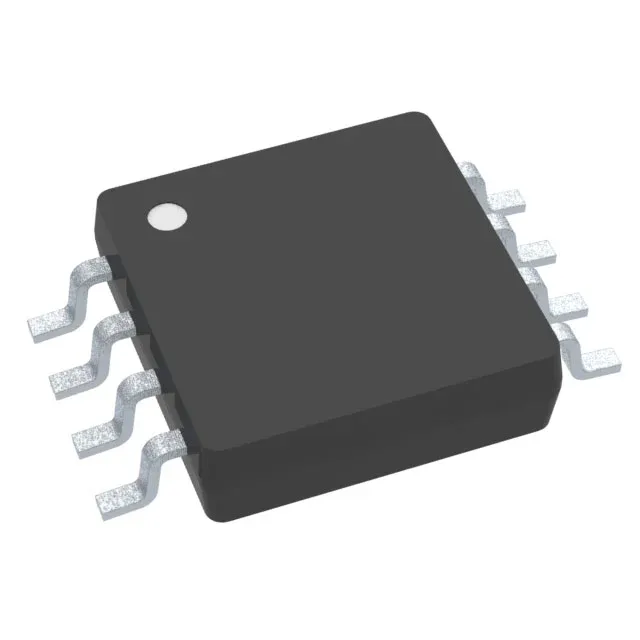
400 Mbps full-duplex LVDS transceiver with military temperature range
The part comes in an 8-VSSOP package (also compatible with 8-TSSOP and 8-MSOP footprints). This is the enhanced-product (EP) variant, built for environments where standard commercial or industrial parts won't survive — avionics, satellite, downhole drilling, and missile-guidance systems that see temperature extremes and need reliable point-to-point or multidrop LVDS links.
Most LVDS transceivers top out at 85°C or 105°C. The trade-off is a premium on the unit cost, but for a production run headed into a sealed enclosure on a military vehicle or a satellite payload, that premium buys qualification traceability and avoids a qualification delta at system level.
Texas Instruments continues to manufacture this EP variant through its standard production lines. There is no last-time-buy window on the horizon, no end-of-life notice in effect. For a BOM that needs a guaranteed supply path for the next several years, this part is a clean line item — no broker dependency, no allocation scramble. The base product number 65LVDS179 is a mature LVDS family with broad second-source overlap across TI's own 65LVDS and 75LVDS lines, so if you ever need to dual-source, the footprint and function are well-covered.
Supply and signal integrity at 400 Mbps
At 400 Mbps, the LVDS output swing is typically 350 mV into a 100 Ω termination. The full-duplex architecture means a single device handles both transmit and receive on separate differential pairs, so one IC replaces two half-duplex transceivers in a bidirectional link. For a point-to-point serial connection between a sensor module and a controller in a high-vibration, wide-temperature environment, this part keeps the signal eye open without external conditioning.