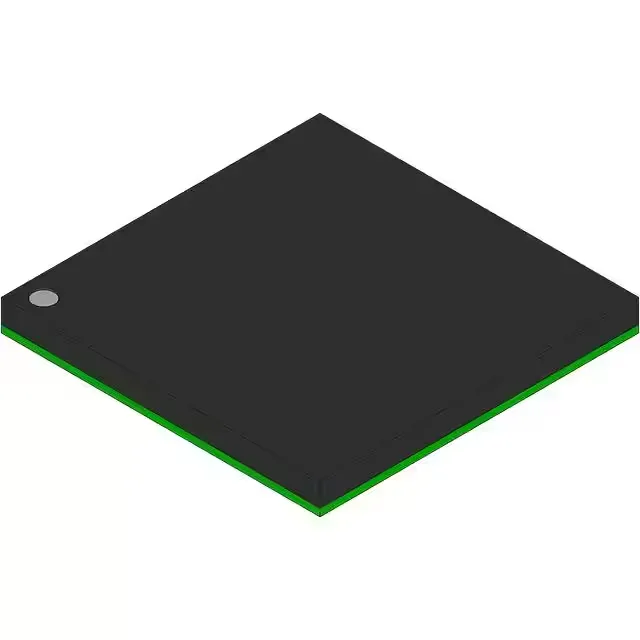
1-to-10 deserializer at 660 Mbps — LVDS in, LVTTL out
The SCAN926260TUFX/NOPB is a single-input, ten-output deserializer from Texas Instruments, part of the SCAN926260 family. It takes one serial LVDS data stream at up to 660 Mbps and fans it out to ten parallel LVTTL signals — the ratio means the parallel side runs at one-tenth the serial rate, so a 660 Mbps serial link yields 66 MHz parallel outputs. This is a bus LVDS deserializer, not a point-to-point SerDes: the LVDS input is designed for multi-drop or multi-point backplane routing where the common-mode range and differential swing tolerate multiple loads on the same pair. The ten LVTTL outputs drive standard 3.3 V logic levels directly into an FPGA, ASIC, or backplane buffer without an external level translator.
196-ball BGA — rework and board-fit
The package is supplied in Bulk (not tape-and-reel), so it ships in trays or tubes. For a rework bench, that means no carrier tape to manage — just ESD-safe tweezers and a stencil aligned to the 15x15 mm footprint. Pin 1 is marked by a chamfered corner on the package body; verify orientation against the board silkscreen before placing.
Supply and temperature — 3.0-3.6 V, -40 to 85°C
The LVDS input is 100-ohm differential terminated on-chip, so no external termination resistor is needed at the receiver end of the backplane trace. The LVTTL outputs source/sink 24 mA typical per pin, enough to drive a point-to-point trace up to a few inches without a buffer.
Active production — no EOL notice
Because it is an active TI part, it is available through authorized distribution channels.