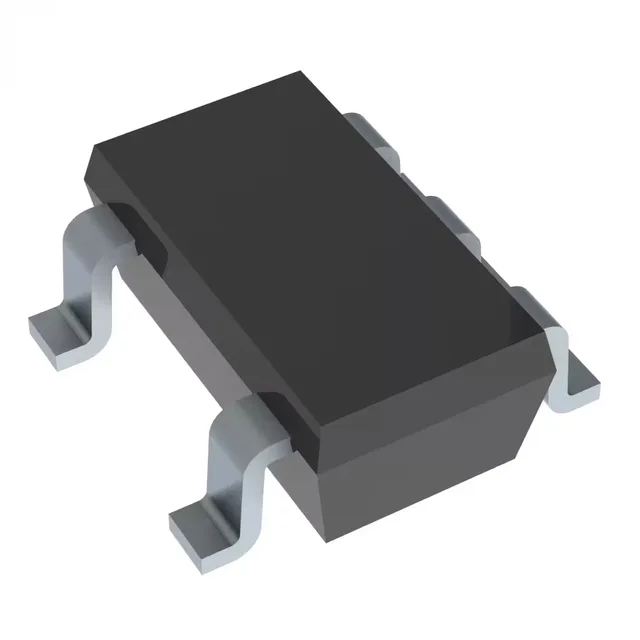
Active production — 100 mA adjustable LDO in SOT-23-5
The REG101NA-A/250: The SOT-23-5 footprint matches the common pinout for this class of linear regulator, so a board already laid out for a generic adjustable LDO in this package accepts the part without a respin. Maximum dropout is 0.13 V at the full 100 mA load — that 130 mV headroom between input and output means the regulator stays in regulation with a 3.3 V rail feeding a 3.0 V output, or a 5.0 V rail feeding a 4.75 V output. Below that margin the output drops out of spec.
Power-supply rejection ratio is 65 dB at 120 Hz, the fundamental ripple frequency from a full-wave rectified 60 Hz line. That means the regulator attenuates 1 V of input ripple to roughly 560 µV at the output — enough to keep an analog front-end or a precision reference from coupling line-frequency hum into the signal chain. The quiescent current is 500 µA typical with a 650 µA maximum supply current. For a battery-powered board drawing 50 mA from the output, the regulator's own consumption adds about 1% to the total load — negligible for most designs but worth noting if the system sleeps at microamp levels.
Protection features and operating range
Built-in over-current and over-temperature protection means the part folds back rather than letting the smoke out if a downstream short or a hot spot pushes it past the safe operating area. The enable pin lets a GPIO or a supervisor IC gate the output — useful for sequencing multiple rails at power-up. The SOT-23-5 package dissipates about 300 mW in still air at 25 °C; at 85 °C ambient the power derates to roughly 200 mW before the thermal shutdown trips.