Dual op-amp that defined a generation — now obsolete
It delivers a 3 MHz gain bandwidth product and a 1.7V/µs slew rate from a single or split supply spanning 10 V to 30 V. Each of the two channels draws 2.5 mA supply current and can source or sink 10 mA at the output.
No last-time-buy window remains open through the factory channel. For a production BOM that still calls out this exact suffix, the only sourcing path is the independent market — surplus inventory, new-old-stock, or broker-sourced material.
1.7V/µs slew rate and 3 MHz GBW — the performance envelope
The 1.7V/µs slew rate limits large-signal bandwidth to roughly 270 kHz at 1 V output swing. For audio line-level signals (±1 V into 10 kΩ) this is sufficient for 20 kHz full-power bandwidth, but the part will slew-limit on higher-amplitude transients above about 27 kHz. The 3 MHz gain-bandwidth product means a non-inverting stage with a gain of 10 has a closed-loop bandwidth of 300 kHz. Unity-gain stable, but the phase margin is not specified — in practice, capacitive loads above 100 pF may need an isolation resistor.
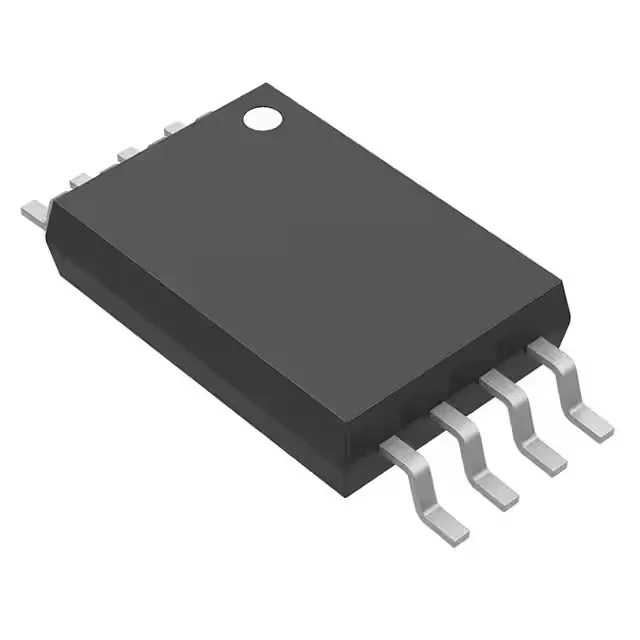
8-TSSOP package — footprint and rework notes
The narrow pitch demands careful solder-paste stencil design — a 0.20 mm stencil thickness with 1:1 aperture-to-pad ratio is typical. Reflow profile follows standard lead-free ramp-soak-peak; no moisture sensitivity level is listed, so assume MSL 1 unless a bake is verified. Do not specify it for outdoor telecom, automotive cabin, or industrial enclosures without active heating/cooling.