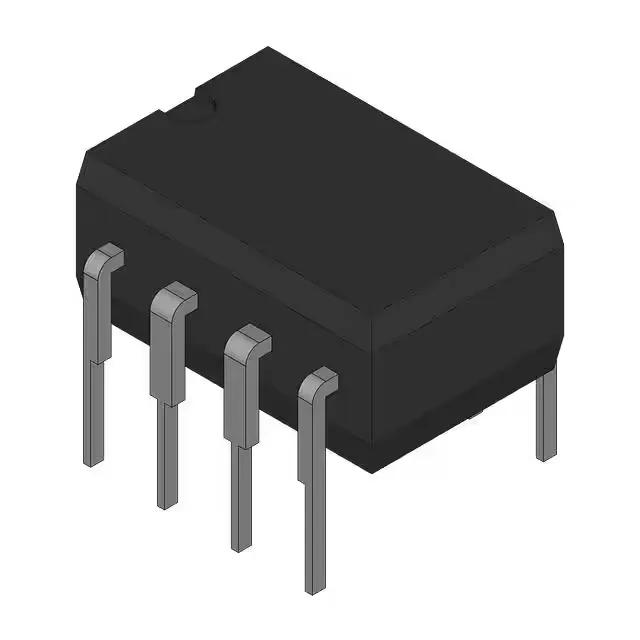
Its 3 MHz gain-bandwidth product and 1.7 V/µs slew rate cover audio signal chains, active filters below 100 kHz, and general-purpose analog conditioning where you don't need the speed or cost of a 10 MHz part. The 2.5 mA per-channel supply current keeps the rail budget manageable in a ±15 V or single 10–30 V design.
Slew rate and bandwidth — the signal ceiling
At 1.7 V/µs, the RC4558PG4 delivers a full-power bandwidth of roughly 270 kHz for a 1 V peak output swing. That's adequate for line-level audio, 4–20 mA loop conditioning, and sensor buffering. Push it above that with a larger swing and the output starts slewing — the waveform rounds off and distortion climbs. For a 10 V peak-to-peak output, the usable bandwidth drops to about 27 kHz. The 3 MHz GBW means you can close a gain-of-10 amplifier and still have 300 kHz of closed-loop bandwidth. That's plenty for most industrial analog front-ends, but not for video, high-speed ADC drivers, or fast comparator applications.
Package and temperature — where it lives on the board
The 8-DIP (0.300-inch row spacing) is a through-hole package that sockets easily and reworks cleanly — no hot-air station needed, no risk of lifting a pad. If the BOM requires -40°C operation, this isn't the part. Supply span is 10 V to 30 V, so it runs on common ±15 V bipolar rails or a single 12 V or 24 V supply. The 150 nA input bias current and 500 µV input offset voltage are typical for a bipolar-input general-purpose op-amp — fine for DC-coupled signals where you can trim the offset or where the signal is large enough that 500 µV doesn't matter.