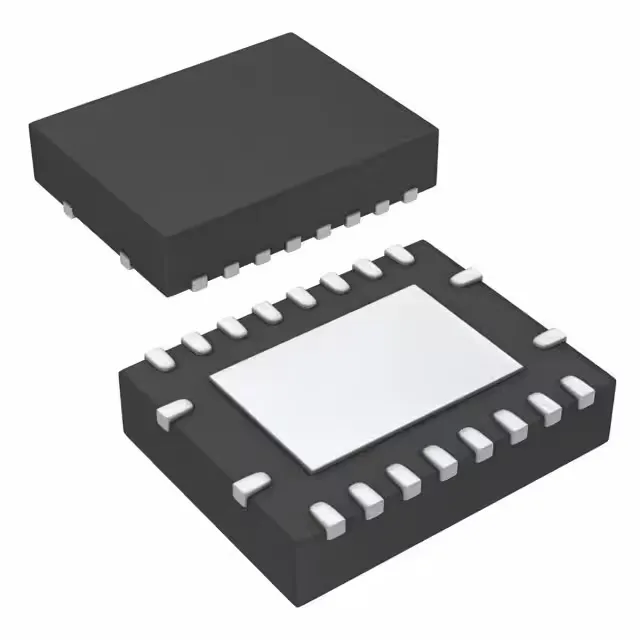
I²C GPIO expander in a 20-VQFN package
The part features a power-on reset (POR) circuit that initializes the I/O ports to a known state, an interrupt output that signals the host on input changes, and push-pull output drivers. The 100 kHz I²C clock frequency is suitable for polling GPIOs at moderate rates — think reading panel buttons, driving indicator LEDs, or latching relay states in industrial control panels and building automation terminals.
Output drive — sink vs source asymmetry
The rated output current is 25 mA sink and 1 mA source per I/O. This asymmetry is the main design constraint: the 25 mA sink can directly drive an LED with a series resistor or a small relay coil, but the 1 mA source limit means you cannot source enough current to bias a typical LED — use a pull-up to the supply or drive the load low-side. If your application needs to source more than 1 mA per pin, consider adding external transistors or selecting a different expander variant.