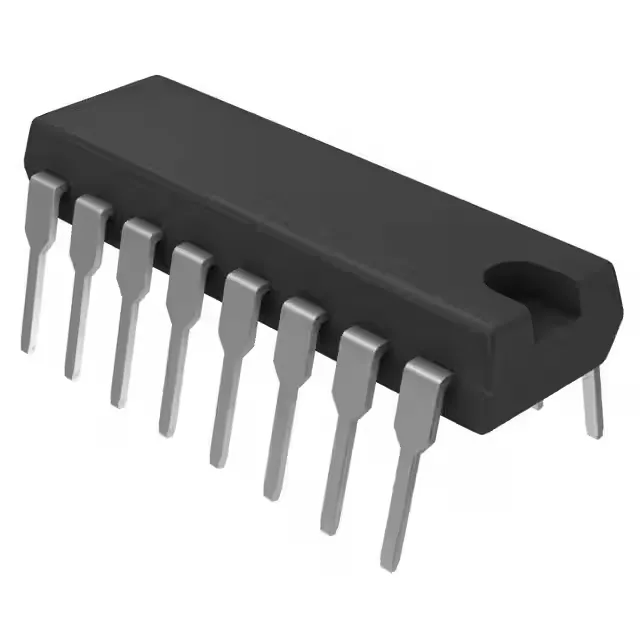
Texas Instruments PCF8574NG4 — Interface & Transceivers

PCF8574NG4 I2C I/O Expander, 8-Bit, 100 kHz, 16-PDIP

MPNPCF8574NG4
End of Life

Texas Instruments PCF8574NG4, 8-bit I2C I/O expander, 100 kHz clock, 2.5V to 6V supply, push-pull outputs, interrupt output, -40°C to 85°C, 16-PDIP (0.300", 7.62mm), Tube.

Independent supplier — new & surplus stockAuthenticity-screened · ESD-safe packingListing updated Aug 2026

Specifications

PCF8574NG4 specifications
ParameterValue
Output typePush-Pull
MountingThrough Hole
Supply voltage2.5V ~ 6V
Current - output source (Sink)1mA, 25mA
Clock frequency100 kHz
InterfaceI²C
Operating temperature-40°C~85°C
PackageTube
FeaturesPOR
Number of i (O)8
Case16-DIP (0.300\", 7.62mm)
Interrupt outputYes

Product details

8-bit I2C I/O expander in a through-hole DIP

It provides eight push-pull output or input ports, each capable of sinking 25 mA or sourcing 1 mA, controlled through a simple two-wire serial interface. The part includes a power-on reset (POR) feature that initializes the outputs to a known state at power-up, and an interrupt output pin that signals the host when an input changes state, eliminating the need for continuous bus polling.

100 kHz I2C bus — timing budget for the system

The 100 kHz clock ceiling on the I2C interface is the standard-mode limit. If your host controller runs at 400 kHz (fast mode) or 1 MHz (fast mode plus), this expander will not keep up — you must configure the I2C master to operate at 100 kHz for this slave. That caps the throughput for reading or writing all eight ports at roughly 10 kbytes per second, which is fine for switch sensing, LED toggling, or relay latching, but too slow for streaming data or high-speed register updates.

25 mA sink, 1 mA source — what you can drive

The asymmetric current drive is the spec to watch when assigning loads to the ports. But the source capability is only 1 mA, so you cannot use a port to directly power a logic gate input or pull up a bus line without an external pull-up resistor. For inputs, the port reads a logic low when the pin is pulled below about 0.8 V at the rated sink current, and a logic high when left floating (internal pull-up is weak, around 100 µA). Plan your external pull-up resistor values accordingly.

Interrupt output for event-driven monitoring

The interrupt output (INT) goes active low whenever any input port changes state from the previous read. This lets the host microcontroller sleep or attend to other tasks instead of polling the I2C bus at a fixed interval. In a multi-expander system, the INT lines can be wire-ORed to a single host interrupt pin, and the host then reads each expander's input register to identify which one triggered the event.

This is a mature, widely second-sourced I2C expander architecture — the base number PCF8574 is used across multiple vendors.

Frequently asked questions

What is the I2C address of PCF8574NG4?

The PCF8574NG4 uses a 7-bit I2C slave address. The three hardware address pins allow up to eight devices on the same bus, with the base address determined by the pin strapping. The address is 0x20 (0100000) when all three pins are tied to GND, and increments with each address pin pulled high.

Does PCF8574NG4 have an interrupt output?

Yes. The PCF8574NG4 includes an interrupt output (INT) that goes active low when any input changes state, allowing the host to respond to events without polling the I2C bus.

Can PCF8574NG4 be used as an input expander?

Yes. Each of the eight ports can be configured as an input by writing a logic 1 to the corresponding output latch. The pin then reads the external logic level when the input register is read. The interrupt output will signal any change on these inputs.

PCF8574NG4 vs PCF8574N – what are the differences?

The PCF8574NG4 and PCF8574N are functionally identical — both are 8-bit I2C I/O expanders with the same 100 kHz clock, push-pull outputs, interrupt, and 2.5 V to 6 V supply range. The 'G4' suffix indicates a lead-free (RoHS-compliant) version of the same die in the same 16-pin DIP package. The PCF8574N is the older tin-lead finish variant. For new designs, the PCF8574NG4 is the preferred RoHS-compliant choice.