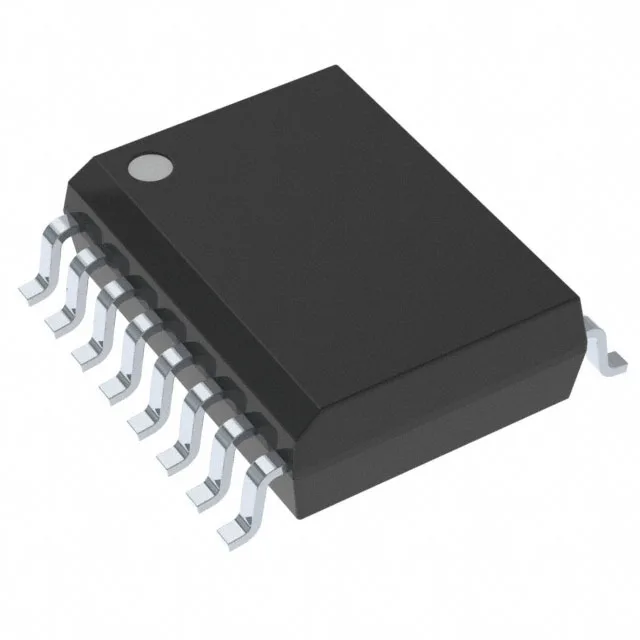
Texas Instruments PCF8574DWRG4 — Interface & Transceivers

PCF8574DWRG4 I2C I/O Expander, 8-bit, 100 kHz, 16-SOIC

MPNPCF8574DWRG4
End of Life

Texas Instruments PCF8574DWRG4, I²C 8-bit I/O expander, 100 kHz clock, 2.5V–6V supply, push-pull outputs, interrupt output, -40°C–85°C, 16-SOIC package.

Independent supplier — new & surplus stockAuthenticity-screened · ESD-safe packingListing updated Aug 2026

Specifications

PCF8574DWRG4 specifications
ParameterValue
Output typePush-Pull
MountingSurface Mount
Supply voltage2.5V ~ 6V
Current - output source (Sink)1mA, 25mA
Clock frequency100 kHz
InterfaceI²C
Operating temperature-40°C~85°C
PackageTape & Reel (TR)
FeaturesPOR
Number of i (O)8
Case16-SOIC (0.295\", 7.50mm Width)
Interrupt outputYes

Product details

8-bit I²C GPIO expander for 2.5V–6V rails

Typical applications include adding digital I/O to microcontrollers with limited pins, reading switches, driving LEDs, and controlling relays in industrial control, telecom, and consumer equipment.

The 2.5V to 6V supply range means this part works with 3.3V logic without a level shifter — a common question when integrating into mixed-voltage designs. At 3.3V Vdd, the I²C bus and GPIO levels are 3.3V-compatible; at 5V, they swing to 5V. The 100 kHz I²C clock is standard-mode only, so plan for a maximum bus speed of 100 kHz when addressing multiple expanders on the same bus.

Output drive and interrupt

Each I/O pin can source 1 mA and sink 25 mA. The interrupt output (active-low) signals the host when any input changes state, eliminating the need for polling and reducing I²C traffic.

The wide body offers better thermal dissipation than the narrow SOIC-16 variant, though at the I/O currents here that is rarely a constraint.

Frequently asked questions

Is PCF8574DWRG4 pin-compatible with PCF8574DWP?

Yes, the PCF8574DWRG4 and PCF8574DWP are pin-compatible — both are the same die in a 16-SOIC (7.50 mm) package. The difference is packaging: the DWRG4 suffix indicates tape-and-reel, while DWP typically ships in tubes. Functionally and footprint-wise they are interchangeable.

Does PCF8574DWRG4 work with 3.3V logic or only 5V?

It works with both. The supply range of 2.5V to 6V covers 3.3V and 5V rails. At 3.3V supply, all I/O and I²C signals are 3.3V-compatible; at 5V supply, they are 5V-compatible. No level shifting is needed when the host runs at the same supply voltage.

How to address multiple PCF8574DWRG4 on the same I²C bus?

The PCF8574 has three address pins that allow up to eight devices on the same I²C bus. Each device gets a unique address by strapping these pins to Vdd or GND. The base address is 0x20 (0100000), and the three address bits give addresses 0x20 through 0x27.

What is the difference between PCF8574 and PCF8575?

The PCF8574 provides 8 I/O lines, while the PCF8575 provides 16 I/O lines. Both use I²C, but the PCF8575 uses a different base address range and has two address pins for up to four devices. The PCF8574 is the 8-bit version; the PCF8575 is the 16-bit version.