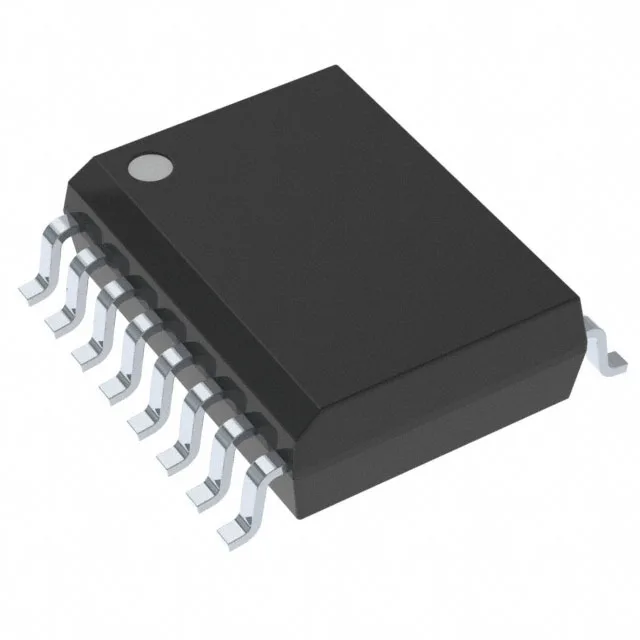
Texas Instruments PCF8574DWR — Interface & Transceivers

TI PCF8574DWR I²C GPIO Expander, 8-Bit, 100 kHz, 16-SOIC

MPNPCF8574DWR
Active

Texas Instruments PCF8574DWR, 8-bit I²C GPIO expander, 100 kHz clock, 2.5V-6V supply, push-pull outputs, interrupt output, POR, -40°C to 85°C, 16-SOIC package.

$1.9500Ref. price · indicative, final on quote
Independent supplier — new & surplus stockAuthenticity-screened · ESD-safe packingListing updated Aug 2026

Specifications

PCF8574DWR specifications
ParameterValue
Output typePush-Pull
MountingSurface Mount
Supply voltage2.5V ~ 6V
Current - output source (Sink)1mA, 25mA
Clock frequency100 kHz
InterfaceI²C
Operating temperature-40°C~85°C
PackageTape & Reel (TR); Cut Tape (CT)
FeaturesPOR
Number of i (O)8
Case16-SOIC (0.295\", 7.50mm Width)
Interrupt outputYes

Product details

The interrupt output (INT) signals the host controller when any input state changes, reducing polling overhead. Typical applications include industrial control panels, server motherboards, and consumer appliances where extra GPIO is needed without adding package pins on the main MCU.

Supply range and logic-level compatibility

The 2.5V to 6V supply range lets the PCF8574DWR operate on both 3.3V and 5V rails without a level shifter. On a 5V bus the I²C signals are 5V-tolerant; at 3.3V the device still meets the 100 kHz clock specification. The push-pull output structure can sink 25 mA per pin, enough to drive an LED directly, but source current is limited to 1 mA — so for sourcing loads like relay coils, use the sink side or add a transistor buffer.

Housed in a 16-SOIC package with 7.50 mm body width (0.295"), the PCF8574DWR uses the wider SOIC-16 footprint, not the narrower 3.9 mm version. Surface-mount assembly is straightforward — standard reflow profile for MSL 1 parts applies.

For volume commitments or long-term supply agreements, the active status gives confidence that the part will be available for new designs.

Frequently asked questions

Is PCF8574DWR discontinued or obsolete?

There is no announced end-of-life or obsolescence for this part.

What is the I2C address of PCF8574DWR?

The PCF8574DWR uses a 7-bit I²C address determined by the three address pins. The base address is 0x20 (0100000), and by tying the address pins high or low you can set any address from 0x20 to 0x27, allowing up to eight devices on the same bus.

Can PCF8574DWR work with 5V supply?

Yes, the PCF8574DWR is specified for a supply range of 2.5V to 6V, so 5V operation is well within its rated limits. At 5V the I²C bus signals are 5V-tolerant, and the output sink current remains 25 mA.

Is PCF8574DWR compatible with 3.3V logic?

Yes, the device operates down to 2.5V, so a 3.3V supply is within spec. The I²C interface at 3.3V still meets the 100 kHz clock rate. Note that the input thresholds scale with VDD, so at 3.3V the VIH minimum is approximately 0.7 × VDD = 2.31V, which is compatible with 3.3V logic outputs.

How many PCF8574DWR devices can be on one I2C bus?

Up to eight PCF8574DWR devices can share a single I²C bus. Each device has three address pins that allow eight unique addresses from 0x20 to 0x27. The 100 kHz clock rate and the bus capacitance limit determine the total number in practice, but eight is the hardware limit.

What is the difference between PCF8574DWR and PCF8574DW?

The PCF8574DWR and PCF8574DW are functionally identical — both are 8-bit I²C GPIO expanders with the same electrical specs. The difference is in the packaging and reel options: the 'R' suffix in PCF8574DWR indicates Tape & Reel packaging, while PCF8574DW typically comes in tubes or trays. For high-volume pick-and-place, the DWR (reel) variant is preferred.