What this 8-bit I²C I/O expander does
It handles the common need — adding digital I/O without burning pins on the main processor, especially in panel controls, sensor readouts, and status-LED banks where you need a handful of inputs or outputs but not a full port expander array. It runs on a 100 kHz I²C clock, which is the standard-rate mode, and talks to any host that supports basic I²C — no special protocol, no clock stretching required. The interface is straightforward: write to the output latch, read the input port. An interrupt output (active-low, open-drain) tells the host when an input changes, so you don't have to poll. Power-on reset (POR) is built in, so the outputs come up in a known high-impedance state — no glitching on power-up.
Each I/O pin can source 1 mA and sink 25 mA. The sink capability is decent for driving LEDs directly (with a series resistor) or pulling a logic line low. The source side is weak — 1 mA won't light most LEDs to useful brightness. For outputs that need to drive high, you'll want an external pull-up or a transistor buffer. The push-pull output structure means you don't need external pull-ups for the outputs themselves, but the weak source current is the real constraint.
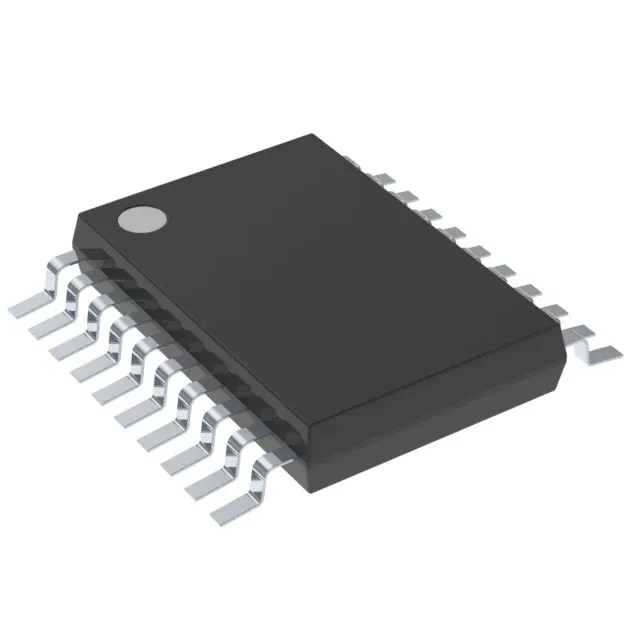
Package and rework — 20-TFSOP
The PCF8574DGVR comes in a 20-TFSOP package (4.40 mm wide, 0.173" pitch). That's a fine-pitch small-outline package — not something you want to hand-solder with a fat iron. A hot-air station with a fine nozzle, some tack flux, and a steady hand will get it on and off without lifting pads. TFSOP is MSL-sensitive like any fine-pitch package.
Not rated for under-hood or downhole use, but fine for the environments where you'd typically find an I²C bus running at 100 kHz.