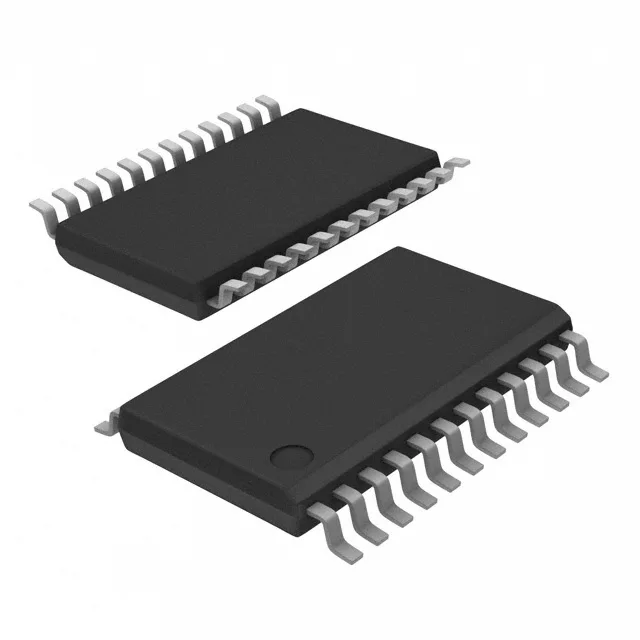
It gives you 16 extra GPIO pins over a two-wire bus, with push-pull outputs that can source 10 mA or sink 25 mA per pin — enough to drive LEDs directly or buffer to a relay coil without an extra transistor. The built-in POR (power-on reset) ensures the outputs come up in a known state, and the interrupt output (INT) lets the host MCU react to input changes without polling the bus every few milliseconds.
Bus speed and footprint
The I²C/SMBus interface runs at up to 400 kHz, fast enough for most GPIO expansion tasks — reading banked switches, toggling indicator LEDs, or latching a set of relays. The 24-TSSOP body (4.40 mm wide) is a common footprint; if you are swapping in a repair, the orientation is straightforward with pin 1 marked on the package top.