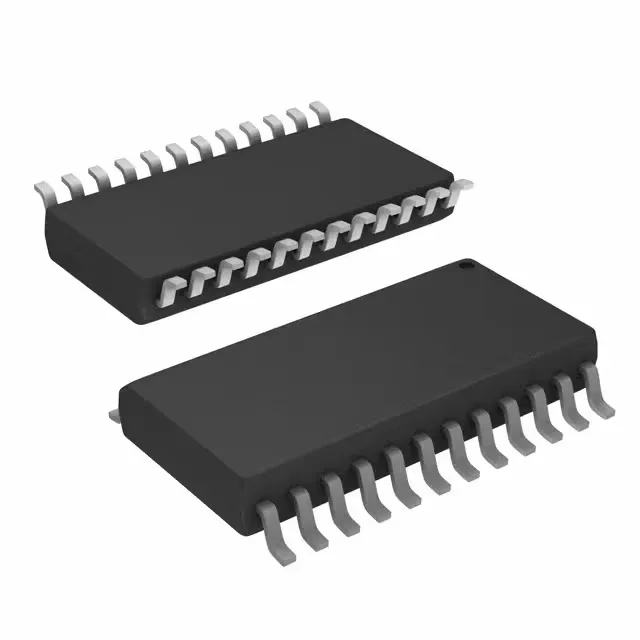
Texas Instruments PCA9555DWR — Interface & Transceivers

PCA9555DWR I²C GPIO Expander, 16-Bit, 400 kHz, 24-SOIC

MPNPCA9555DWR
Active

Texas Instruments PCA9555DWR, 16-bit I²C/SMBus GPIO expander, 400 kHz clock, push-pull outputs, 2.3 V–5.5 V supply, -40°C to +85°C, 24-SOIC package.

$2.5200Ref. price · indicative, final on quote
Independent supplier — new & surplus stockAuthenticity-screened · ESD-safe packingListing updated Aug 2026

Specifications

PCA9555DWR specifications
ParameterValue
Output typePush-Pull
MountingSurface Mount
Voltage2.3V ~ 5.5V
Current - output source (Sink)10mA, 25mA
Frequency400 kHz
InterfaceI²C, SMBus
Operating temperature-40°C~85°C
PackageTape & Reel (TR); Cut Tape (CT)
FeaturesPOR
Number of i (O)16
Case24-SOIC (0.295\", 7.50mm Width)
Interrupt outputYes

Product details

It provides 16 configurable push-pull I/O pins in a compact 24-SOIC package, saving microcontroller GPIOs on dense boards. The part includes a power-on reset (POR) feature that initializes all I/O as inputs, and an interrupt output pin signals the host when an input changes state — useful for keeping the main processor in a low-power sleep mode until a button press or sensor edge occurs.

Supply range and I/O drive — sizing the rail and the load

The total package dissipation limits how many pins can run at full drive simultaneously; derate per the datasheet's thermal curves above 85°C ambient.

Interrupt output — why it matters for low-power designs

The interrupt output (INT) is a key feature for battery-operated or power-conscious systems. Instead of the host MCU polling the expander over I²C to check for input changes, the INT pin pulls low when any input configured as an interrupt source changes state. The host can stay in a deep-sleep mode and wake only on the interrupt edge, saving significant quiescent current. The interrupt is cleared by reading the input port register, so the I²C transaction is minimal.

The base product number PCA9555 covers multiple package variants (SOIC, TSSOP, QFN), so if the 24-SOIC footprint is a constraint, the PW (TSSOP) or RGY (QFN) siblings are pin-compatible and share the same I²C address map and register set.

Frequently asked questions

Is PCA9555DWR compatible with 3.3V I2C?

Yes. The I/O pins also accept 3.3 V logic levels when the expander is powered from 3.3 V, so no level translation is needed between a 3.3 V host MCU and this part.

Does PCA9555DWR have an interrupt output?

Yes, it includes a dedicated interrupt output pin that asserts low when any input configured for interrupt generation changes state. This allows the host controller to avoid continuous polling.

What is the difference between PCA9555DWR and PCA9555PW?

The two parts are functionally identical — same 16-bit I²C GPIO expander, same register map, same supply range and temperature grade. The difference is the package: PCA9555DWR comes in a 24-SOIC (7.50 mm wide body), while PCA9555PW is in a 24-TSSOP (4.40 mm wide). The SOIC is easier to hand-solder and inspect; the TSSOP saves board area. Both are active and pin-compatible.