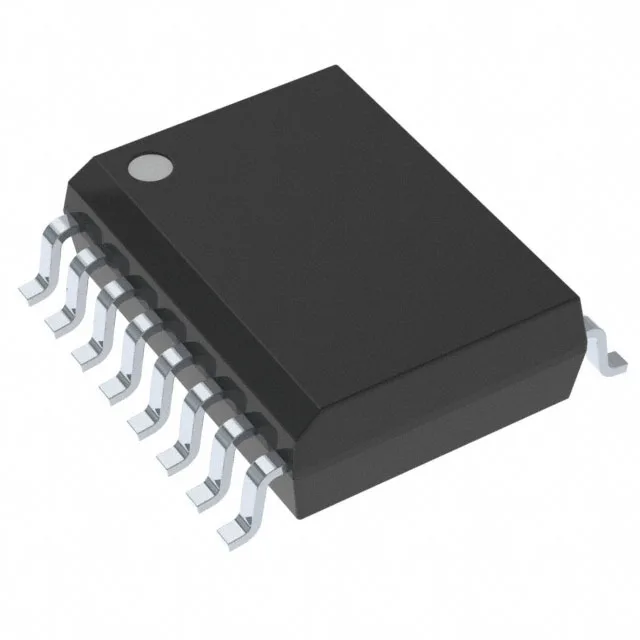
It provides eight push-pull I/O ports that can be configured as inputs or outputs, with a power-on reset (POR) circuit that initializes the I/Os as inputs. Typical applications include server and telecom backplane GPIO expansion, industrial sensor monitoring, and LED or relay control where the host MCU lacks enough pins. The interrupt output (active-low) signals the host when an input changes, reducing polling overhead on the I²C bus.
I²C bus speed and system timing
The PCA9554DWR supports a 400 kHz clock frequency, which is the Fast-mode standard for I²C. At this rate, a single bus can host multiple expanders and other peripherals; the practical limit depends on total bus capacitance and the number of devices. For a design that polls eight inputs at 400 kHz, the latency per read is about 100 µs including addressing and acknowledge — fast enough for pushbutton, limit switch, or encoder feedback, but not for high-speed quadrature decoding.
Output drive and load considerations
Each I/O can source 10 mA or sink 25 mA. The push-pull output eliminates the need for pull-up resistors on outputs, but inputs still require external pull-ups if open-drain behavior is needed.
The base product number PCA9554 covers multiple package variants (D, DW, PW), all sharing the same I²C register map and software interface.