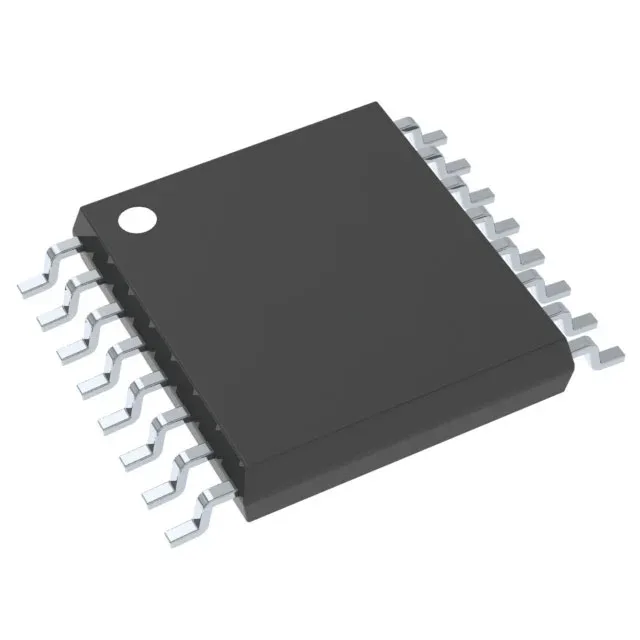
8-bit I/O expander for I²C bus expansion
It provides eight push-pull GPIOs controlled over a two-wire serial bus, with a 400 kHz clock rate and an interrupt output that signals the host when an input changes.
The I²C pins are 5 V tolerant when the device is powered at 3.3 V, which is common for mixed-voltage designs. Output source/sink capability is 10 mA source, 25 mA sink per pin — enough to drive a small LED or a logic-level MOSFET gate directly, but not a relay coil without a buffer.
POR and interrupt: two features that simplify the BOM
The POR feature resets the internal registers on power-up, so the I/O pins start as inputs (high-impedance) without a dedicated reset pin or an external reset IC. The interrupt output pulls low when an input pin changes state; the host reads the expander over I²C to identify which pin changed. This saves the host from polling the I²C bus and reduces software overhead in interrupt-driven control panels or keypad scanners.
Texas Instruments lists the base product number PCA9554, which spans multiple package and temperature variants. For dual-sourcing or a second-source option, the PCA9554 family is second-sourced by NXP under the same base number — the PCA9554PW,118 is a pin-compatible 16-TSSOP variant. Confirm the exact suffix for your BOM; the PW,118 is Tape & Reel, while the PWG4 is Tube.