Its 1 MHz gain-bandwidth product and 0.6 V/µs slew rate mean it handles audio-frequency signals and slow ADC drive cleanly, but it will visibly distort a 100 kHz square wave — keep the output swing modest if you need fast edges.
Rail-to-rail output and input bias — where it works and where it doesn't
The output swings rail-to-rail, so you get the full supply range into an ADC or comparator without losing headroom. Input common-mode range is not rail-to-rail on this family — the datasheet typical input range goes to about 1.5 V below the positive rail at 5 V supply, so high-side current sensing at 3.3 V single supply needs a different part. The 1 pA input bias current lets you interface directly to high-impedance sources like pH probes or photodiode amplifiers without an external JFET buffer. Supply range runs from 4 V to 12 V, which covers most 5 V and 12 V industrial rails but not 3.3 V systems.
Package and temperature — field-swap reality
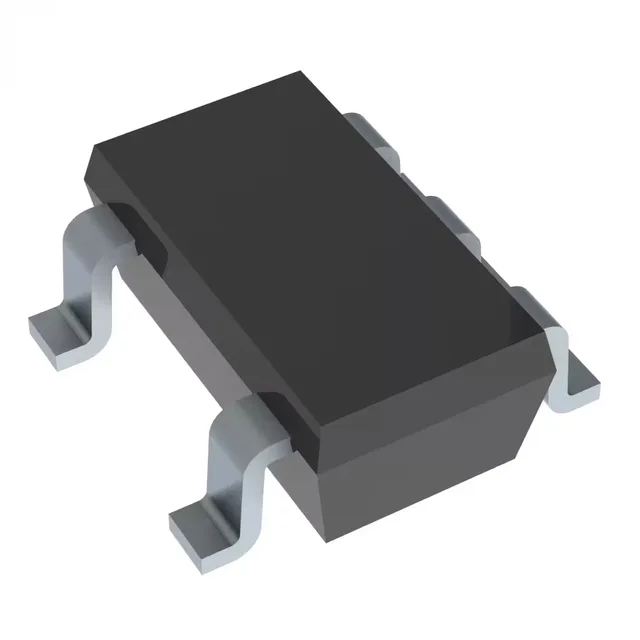
Marking is typically a three-character code on the package body; orientation is standard with pin 1 at the top-left when the marking is read upright, so you can get it right without a magnifier on a good day.