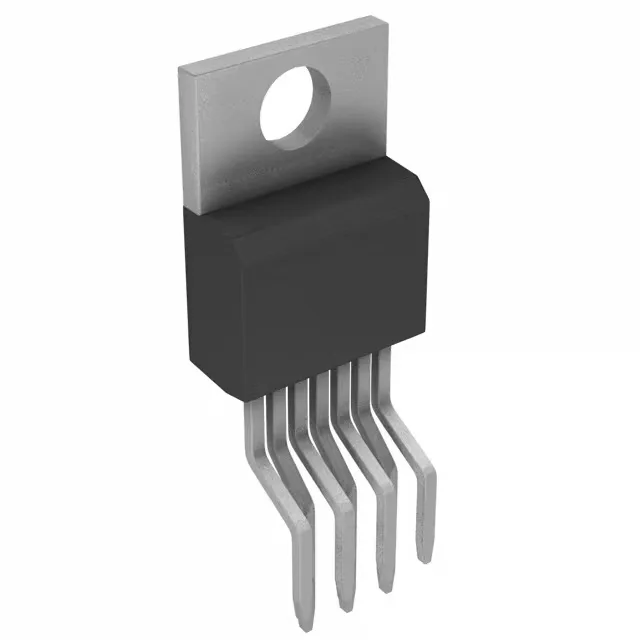
The Texas Instruments OPA547TG3 is a general-purpose operational amplifier built to deliver real current — 750 mA per channel — from a single supply spanning 8 V to 60 V. That output capability, combined with a 1 MHz gain-bandwidth product and 6 V/µs slew rate, puts it in the class of power op-amps used to drive motors, valves, solenoids, audio transducers, and heavy test-fixture loads. The TO-220-7 package with formed leads lets you bolt it to a heatsink or a chassis wall, which is exactly what you want when the load current is measured in hundreds of milliamps and the ambient hits 85°C.
Output current and supply range — the two numbers that define the BOM fit
The 750 mA output per channel is the headline spec that separates this part from a garden-variety op-amp. If your design needs to swing a few hundred milliamps into an inductive or resistive load — a proportional valve, a small DC motor, a headphone amplifier — the OPA547TG3 can do it without an external buffer transistor. The 8 V to 60 V supply span means it runs on common industrial rails (12 V, 24 V, 48 V) without a secondary regulator. The 10 mA quiescent supply current is modest for a power amplifier; the thermal budget is dominated by the load, not the bias.
Package and mounting — through-hole for power dissipation
The TO-220-7 package with formed leads is a through-hole power package. The formed leads are pre-bent for vertical mounting on a PCB or for flying-lead wiring in a panel-mount assembly.
It is not rated for the full automotive temperature range (125°C junction) or for down-hole / avionics extremes, but within its envelope the 750 mA output holds across the temperature range — derating is driven by the package's thermal resistance, not the silicon.