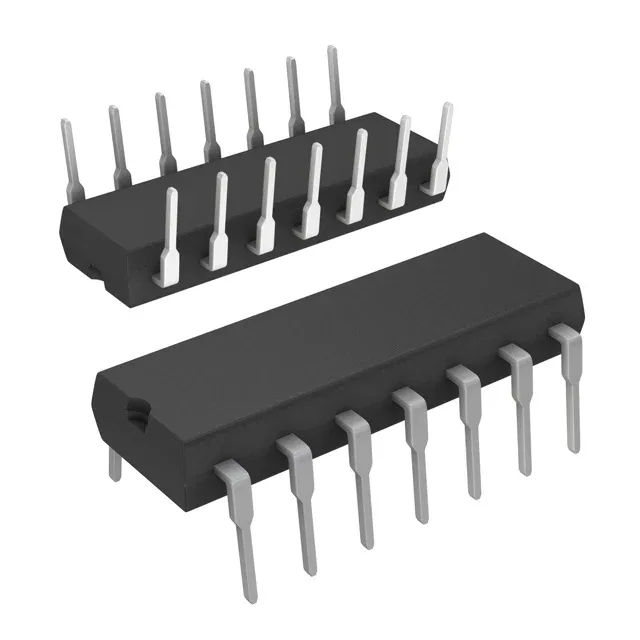
It delivers 33 MHz gain-bandwidth product and 11V/µs slew rate across a 5 V to 36 V supply range, with a 10 µV input offset voltage that puts it in the precision category for a quad op-amp. Each of the four channels can source or sink 45 mA, and the input bias current sits at 2.5 nA — low enough for most sensor conditioning and active filter stages without the cost of a CMOS-input part.
The 33 MHz gain-bandwidth product sets the usable closed-loop gain range: at a gain of 10 you have about 3.3 MHz of small-signal bandwidth, enough for audio, ultrasonic sensing, and many control-loop feedback paths. The 11V/µs slew rate means the large-signal response won't limit you below roughly 175 kHz at 20 Vpp output — fine for power-supply sequencing, motor-current sense, and general-purpose analog processing. If your design needs faster edges or wider bandwidth, you would step up to a current-feedback or higher-slew-rate part; if you only need a few hundred kHz, this part gives you phase-margin headroom that a slower amplifier might not.
10 µV offset — the precision angle
It means the OPA4228PA can handle DC-accurate amplification without external trimming in many applications — weigh-scale bridges, thermocouple amplifiers, and precision integrators. The 2.5 nA input bias current is bipolar, not FET-level, so source impedance matters: keep it below 10 kΩ to avoid offset drift from bias current.
Package and lifecycle
The OPA4228PA comes in a 14-DIP (0.300", 7.62 mm) through-hole package, also specified as the 14-PDIP supplier device package. The product status is Active and it is ROHS3 compliant. The PDIP body is 0.300 inch wide, the standard narrow DIP footprint that fits breadboards, prototype boards, and wave-solder production lines.