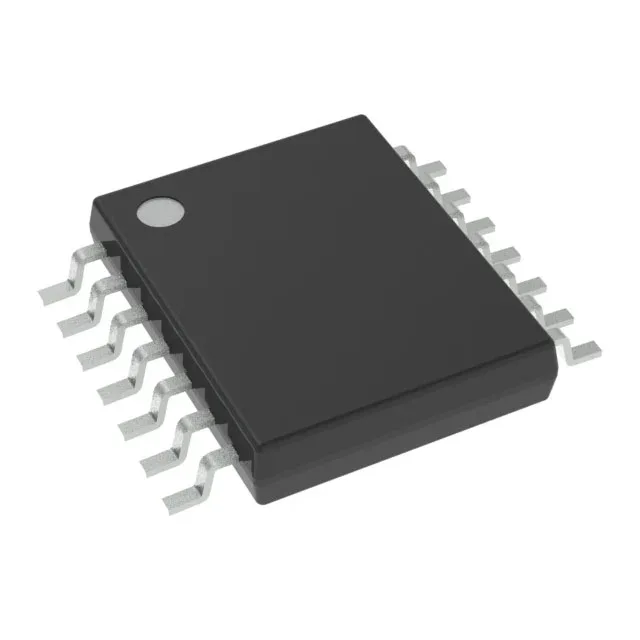
Quad op-amp for industrial and automotive signal chains
Its 18 MHz gain-bandwidth product and 6.4 V/µs slew rate suit it for active filters, data-acquisition front-ends, and motor-drive current-sense conditioning where four amplifiers share a common supply and temperature environment. The 35 µV typical input offset keeps DC errors low without external trimming, and the 65 mA per-channel output drive can directly swing ADC inputs or small relays.
With an 18 MHz gain-bandwidth product, the OPA4209AIPWR maintains a closed-loop gain of 10 up to about 1.8 MHz before the open-loop rolloff cuts in — enough for precision filtering of PWM frequencies or anti-aliasing in 12-bit ADC chains sampling at a few hundred kHz. The 6.4 V/µs slew rate means a 10 V output step settles in roughly 1.6 µs, so large-signal waveforms at tens of kHz stay clean. For designs running near the 125°C end of the range, the 35 µV offset may drift a few microvolts per degree; budget that if the system demands sub-mV accuracy across temperature.
The 4.5 V minimum supply lets the quad op-amp run from a 5 V rail common in industrial control, while the 36 V maximum covers 24 V industrial buses with margin. The 65 mA per-channel output current can drive a 50 Ω load to within a volt of the rails, handy for coaxial cable drivers or transformer-coupled stages. Each channel draws 2.2 mA quiescent, so the full quad consumes about 8.8 mA — reasonable for multi-channel data-acquisition boards where power is budgeted per amplifier.
The Tape & Reel option suits automated pick-and-place; Cut Tape is available for prototyping. The 0.65 mm pin pitch is standard for TSSOP-14, and the package is RoHS3 compliant.
For dual-sourcing resilience, the OPA4374AIPWT is a quad rail-to-rail CMOS op-amp in the same TSSOP-14 footprint, but its 6.5 MHz GBW and 5 V/µs slew rate are a step down in bandwidth — verify the speed margin before substituting.