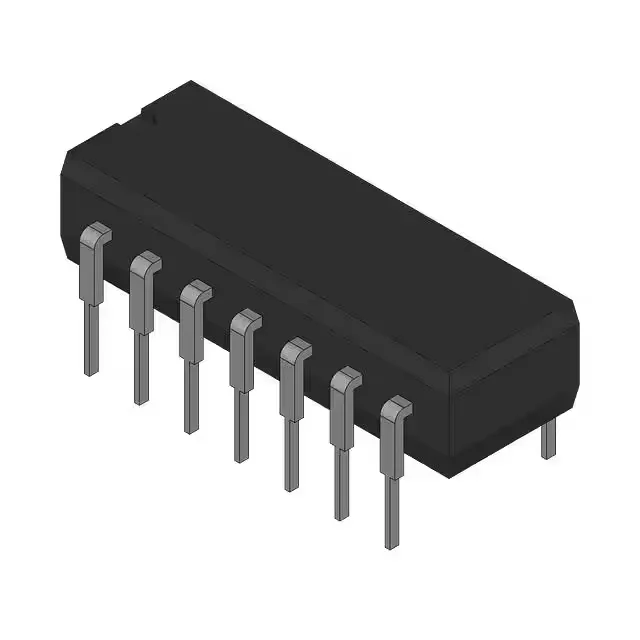
It delivers 4 MHz gain-bandwidth product and a 10 V/µs slew rate, with a 5 pA typical input bias current from the JFET front end. The four amplifiers share a common supply range of 9 V to 36 V, drawing 1.5 mA per channel quiescent current. This part is aimed at precision analog signal conditioning — sensor buffers, active filters, data-acquisition front ends — where high input impedance and low bias current matter more than rail-to-rail output swing.
Package and mounting — through-hole only, no tape/reel option
The package is a 14-lead PDIP (0.300" row spacing), intended for through-hole soldering — either wave-solder or hand-assembly. If your production line is pick-and-place only, this part will require a separate through-hole insertion step or a socket. The supplier device package is 14-PDIP, identical to the JEDEC MS-001-AA footprint.
A 10 V/µs slew rate means the output can swing 10 V in 1 µs, which is sufficient for audio-frequency signals up to about 200 kHz full-power bandwidth (10 V peak-to-peak). The 4 MHz gain-bandwidth product supports closed-loop gains up to 40 dB at 40 kHz or unity-gain buffers up to 4 MHz, though the phase margin will tighten near the top end. For precision DC applications, the 200 µV typical input offset voltage and 5 pA bias current keep errors low in high-impedance circuits like photodiode amplifiers or pH probe buffers.
It is not qualified to AEC-Q100, so automotive use would require additional qualification effort. The 36 V maximum supply span gives headroom for 24 V industrial rails with margin for transients.
For BOM lines that need a through-hole quad JFET op-amp, this part is a stable, non-obsoleting choice.