Signal-chain fit for battery-powered sensor interfaces
The OPA364AIDBVT is a single-channel general-purpose op-amp with a 7 MHz gain-bandwidth product and a 5 V/µs slew rate — enough bandwidth to condition signals from a 100 kHz sensor bridge without significant phase lag, and the slew rate supports a 2 Vpp output swing at 1 MHz without slew-induced distortion. Its rail-to-rail output stage and 1.8 V to 5.5 V supply span let it run directly from a single lithium-ion cell or a 3.3 V rail, driving the full ADC input range without a negative supply.
Input bias and offset — what they mean for sensor front-ends
The 1 pA typical input bias current at 25 °C means the voltage error across a 10 MΩ source impedance is only 10 µV — negligible for a precision thermocouple or pH probe front-end. At 125 °C the bias roughly doubles every 10 °C, so budget ~64 pA at the high end, still manageable for a 100 kΩ source. Maximum input offset voltage is 1 mV — for a gain of 100, that translates to 100 mV of DC error at the output, which is acceptable for many industrial sensor interfaces but may need a digital calibration step for sub-0.1% accuracy systems.
Supply current and output drive in multi-channel designs
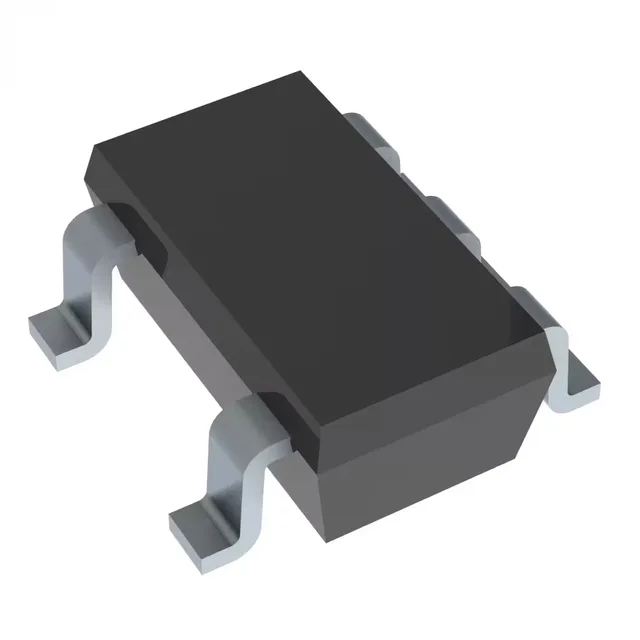
Drawing 1.1 mA per channel, the OPA364AIDBVT keeps the total power budget under 6 mW at 5 V — a four-channel design using four of these parts stays under 25 mW, well within the thermal envelope of a compact SOT-23-5 layout. The output can source or sink 85 mA, enough to drive a 50 Ω load to within 200 mV of the rails — useful for directly feeding a 50 Ω coaxial cable or a low-impedance ADC input without a separate buffer.
Active production — no lifecycle risk for new designs
The -40°C to +125°C operating temperature range qualifies it for industrial control cabinets and under-hood automotive sensor modules where ambient temperatures push past 85°C.