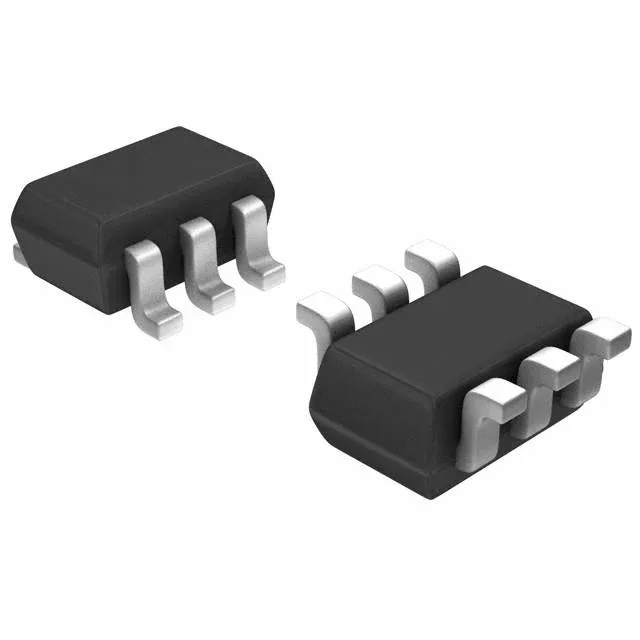
Video filter amp in a tiny SC-70-6 — what the 8.5 MHz bandwidth buys you
Its 8.5 MHz -3 dB bandwidth is set for standard-definition video (NTSC/PAL) reconstruction filters, where the passband needs to preserve luminance and chrominance content while rolling off above the video carrier to suppress out-of-band noise and DAC artifacts. Supply range is 2.5V to 3.3V single supply, suiting it for battery-powered or 3.3V-rail video systems in portable media players, security cameras, and automotive rear-seat entertainment modules.
80 mA output drive — why it matters for the 75-ohm line
Driving a standard 75-ohm video load at 2V peak-to-peak requires about 27 mA of output current. The OPA362AIDCKT's 80 mA output per channel gives you nearly 3x margin over that requirement, which means the amplifier stays well within its linear region and the output swing is not clipped or distorted on sync tips or white peaks. That headroom also covers the extra current needed if the output is AC-coupled through a series capacitor and the load impedance drops at higher frequencies. For a BOM engineer, this drive spec means you can skip a second gain stage or a discrete emitter-follower buffer — the OPA362 handles the line directly.
For a production BOM, this removes the single-source obsolescence risk that haunts older video filter parts.
SC-70-6 footprint — what the layout engineer needs
The OPA362AIDCKT is supplied in a 6-lead SC-70-6 package (also known as SOT-363 or 6-TSSOP). The body is roughly 2.0 mm x 2.1 mm with a 0.65 mm lead pitch. For the PCB layout engineer, this is a fine-pitch SMD package that requires careful solder paste stencil design — a 0.5 mm aperture width and 0.15 mm stencil thickness is a typical starting point. Place a 0.1 µF ceramic decoupling capacitor within 2 mm of the supply pin (pin 5) to keep the power rail clean at 8.5 MHz. The part is specified for surface-mount assembly only.