Micro-power precision for battery and sensor front-ends
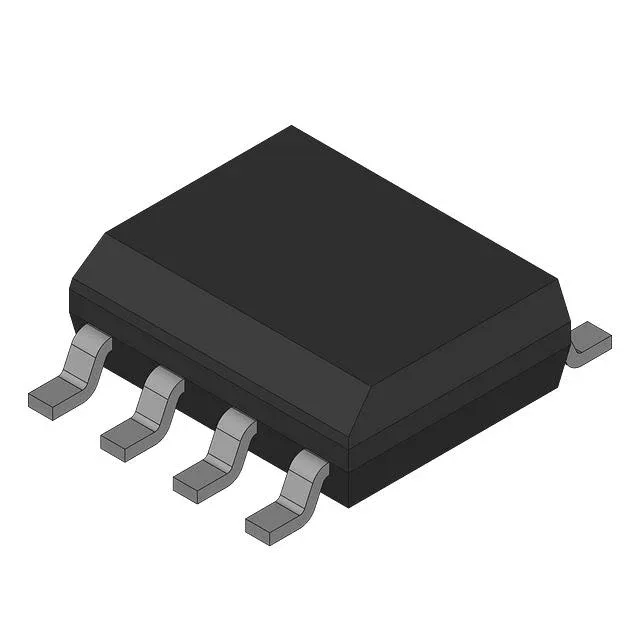
It draws just 20 µA of quiescent current while delivering a 100 kHz gain-bandwidth product and a 0.03 V/µs slew rate — numbers that place it squarely in the micro-power signal-conditioning class, not the high-speed or high-output-drive tier. Output swings rail-to-rail, preserving dynamic range in low-voltage single-supply rails from 2.3 V up to 5.5 V. The 5 mA per-channel output current limits direct drive to light loads — think ADC input buffers or reference inputs, not a headphone or relay coil. Packaged in an 8-SOIC (0.154" body width), it is a drop-in footprint for any general-purpose op-amp layout in that package.
20 µA supply — what it costs in bandwidth and drive
The 20 µA supply current is the headline differentiator. For a battery-powered sensor node running on a CR2032 coin cell, that quiescent draw is roughly one-tenth of what a standard 250 µA op-amp would consume, extending months of always-on operation. The trade-off is visible in the 100 kHz gain-bandwidth and 0.03 V/µs slew rate — this part handles DC and low-frequency AC signals (audio below 20 kHz, strain gauge, temperature) but will slew-limit on a 1 kHz square wave above a few hundred millivolts. If the BOM calls for driving a heavier load, the TLV9351IDCKR (3.5 MHz, 20 V/µs, 60 mA output) or TLV9362IDDFR (10.6 MHz, 25 V/µs, 60 mA) are in the same rail-to-rail general-purpose family but consume 600 µA and 2.6 mA respectively — a different power budget entirely.