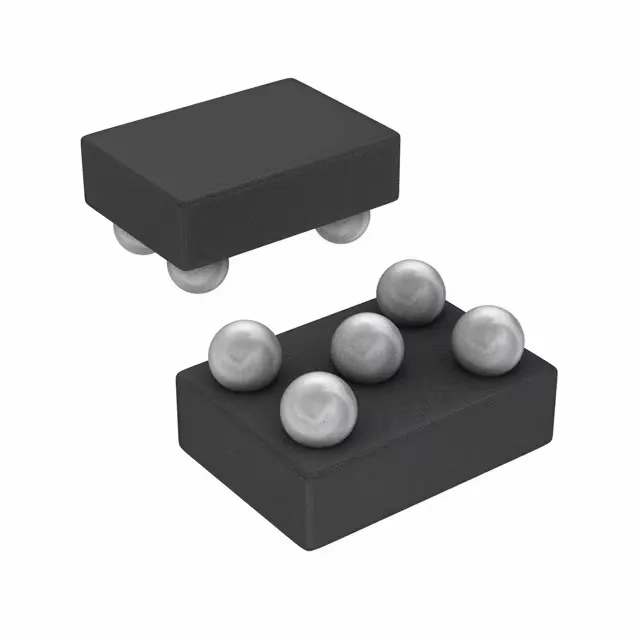
5-DSBGA zero-drift op-amp for precision signal chains
The OPA330AIYFFR is a single-channel zero-drift operational amplifier from Texas Instruments, packaged in a 5-bump DSBGA (1.12 x 0.82 mm) that demands a controlled fine-pitch assembly process — the 0.5 mm ball pitch requires a solder mask defined pad and a reflow profile matched to the package's moisture sensitivity. With a gain-bandwidth product of 350 kHz and a slew rate of 0.16 V/µs, this part is sized for DC-accurate amplification in low-frequency sensor interfaces, not for high-speed data acquisition — the bandwidth limits the closed-loop gain-bandwidth trade-off for signals above a few tens of kilohertz. The 8 µV typical input offset voltage, combined with the zero-drift topology, keeps the DC error below 10 µV over the full -40°C to 125°C industrial temperature range — a meaningful advantage for thermocouple, strain-gauge, or bridge-type front ends where the signal amplitude is in the millivolt range and the offset drift of a standard op-amp would dominate the error budget.
21 µA supply current and rail-to-rail output for battery-powered designs
Quiescent current is 21 µA typical, which places the OPA330AIYFFR in the micropower class — a battery-powered sensor node that runs continuously draws under 25 µA from the op-amp alone, leaving the bulk of the power budget for the ADC, microcontroller, and wireless link. The rail-to-rail output stage swings within 10 mV of the supply rails at light loads, preserving the full ADC input range in a single-supply 1.8 V to 5.5 V system — the 5 mA output current per channel is sufficient to drive the reference input of a successive-approximation ADC or a low-impedance analog multiplexer. Input bias current is 200 pA typical at 25°C, doubling roughly every 10°C — at 85°C it is approximately 3.2 nA, still low enough for a 10 kΩ source impedance but significant for a 1 MΩ piezoelectric or pH probe front end where the bias current develops a voltage error across the source resistance.
Active production with ROHS3 compliance
ROHS3 compliant per the current revision, with no exemptions for lead in solder or other restricted substances — the part ships in tape-and-reel or cut-tape format, and the DSBGA package is compatible with lead-free reflow profiles per JEDEC J-STD-020.