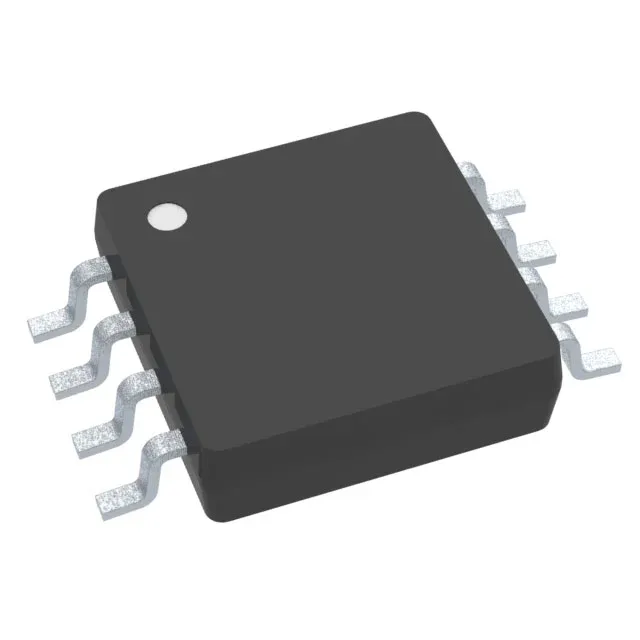
Dual voltage-feedback amp at 170 µA per channel — the power/speed trade-off
The Texas Instruments OPA2834IDGKT packs two voltage-feedback amplifiers into an 8-VSSOP package, delivering 20 MHz gain-bandwidth product and 26 V/µs slew rate while drawing just 170 µA per channel. That ratio — 20 MHz GBW at 170 µA — puts it in the class of low-power signal-conditioning amps where you need bandwidth without burning the battery budget.
Slew rate and supply current — the design decision
The 26 V/µs slew rate at 170 µA per channel is the defining spec pair. For a 20 MHz GBW amp, 26 V/µs gives you enough large-signal bandwidth to drive a 2 Vpp signal to 20 MHz without slew-rate limiting.
Package and supply — footprint and rail planning
The 8-VSSOP package measures 3.00 mm x 3.00 mm body, 0.65 mm pitch — a compact dual-op-amp footprint that fits tight mixed-signal boards. No exposed thermal pad, so heat dissipation relies on the copper pour and via stitch under the device; the 20 mA per-channel output current is the practical ceiling for continuous drive into 50 Ω or 75 Ω loads. The 2.7 V floor is useful for designs running from a Li-ion cell near end-of-discharge.
The 8-VSSOP package is a standard TI footprint, so supply continuity through the catalog channel is stable. If you are dual-sourcing for volume production, the closest parametric match in the same supply-and-package class is the TLV9362IDDFR — same dual-channel rail-to-rail output, 10.6 MHz GBW vs 20 MHz, 25 V/µs slew rate, and 2.6 mA supply per channel vs 170 µA. The TLV9362 draws more current but offers lower input bias (10 pA) and a wider supply range up to 5.5 V. For designs where the OPA2834's 170 µA per channel is the critical spec, there is no direct pin-compatible second source at that power level — the BOM should lock the OPA2834 as the sole source unless you can accept the higher supply current of the TLV9362.