105 MHz bandwidth, 243V/µs slew — signal fidelity for high-speed paths
The OPA2810IDCNT is a dual voltage-feedback op-amp from Texas Instruments that delivers 105 MHz -3dB bandwidth and a 243V/µs slew rate. That slew rate means the output can swing rail-to-rail on a 5 V supply in about 20 ns — fast enough to preserve the edge shape on a 10 MHz square wave without visible rounding. Each of the two channels draws 3.7 mA supply current, so the total quiescent draw for the dual package is 7.4 mA. The 70 MHz gain-bandwidth product tells you the usable closed-loop bandwidth at a given gain: at a gain of 10, expect roughly 7 MHz of flat response before the -3 dB roll-off.
SOT-23-8 package — hand-solderable and board-space efficient
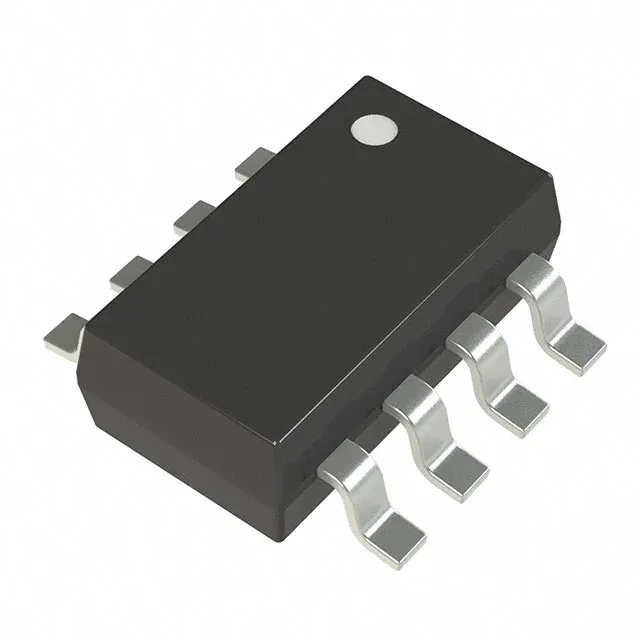
Housed in an SOT-23-8 package, this op-amp is small enough for dense layouts but still hand-solderable with a fine-tip iron and some patience. The 0.65 mm pin pitch is manageable with a decent magnifier — no hot-air rework station required for prototyping. The rail-to-rail output stage means the signal swing reaches within millivolts of the supply rails, which is useful when running from a single 5 V or 3.3 V rail and you need every bit of dynamic range for an ADC input.
Industrial temperature range and low input bias
Rated for -40°C to 125°C ambient, this part fits into motor-drive feedback, industrial sensor conditioning, or under-hood automotive signal chains where the board sees temperature cycling. The 2 pA typical input bias current means it won't load a high-impedance source like a pH probe or a photodiode — the offset error from bias current stays negligible even with 1 MΩ source resistance.
Supply range and output drive
Operates from 4.75 V to 27 V total supply span — that covers single-supply 5 V systems all the way up to ±12 V or ±15 V dual-supply rails. Each channel can source or sink 108 mA, enough to drive a 50 Ω terminated line or a moderate capacitive load like a sample-and-hold input. Input offset voltage is 100 µV typical, which for a 10-bit ADC with a 5 V reference represents about 0.2 LSB of DC error — well within the noise floor for most precision measurements.