Active production — safe for new BOM lines
The OPA2673IRGVT: You can design it into a new board without worrying about a mid-lifecycle obsolescence scramble. ROHS3 compliant, so it passes the EU material declaration gate without an exemption review.
3500 V/µs — what that slew rate buys you
The 3500 V/µs slew rate is the headline number that separates this part from general-purpose op-amps. In a current-feedback topology, slew rate does not degrade as closed-loop gain increases — a voltage-feedback amp with the same gain-bandwidth product would slow down noticeably at gains above 2 or 3. Paired with 600 MHz -3 dB bandwidth, the OPA2673IRGVT handles large-signal pulses and small-signal sine waves up into the VHF range without slewing into distortion. That matters for ADSL/VDSL line drivers where the crest factor of the DMT signal demands both high slew rate and wide bandwidth simultaneously. 700 mA output current per channel means it drives low-impedance loads — think 10-25 ohm transformer primary windings in xDSL or cable modem transmit paths — without hitting the current limit on peaks.
Dual-channel in a 4×4 mm VQFN — board-space tradeoffs
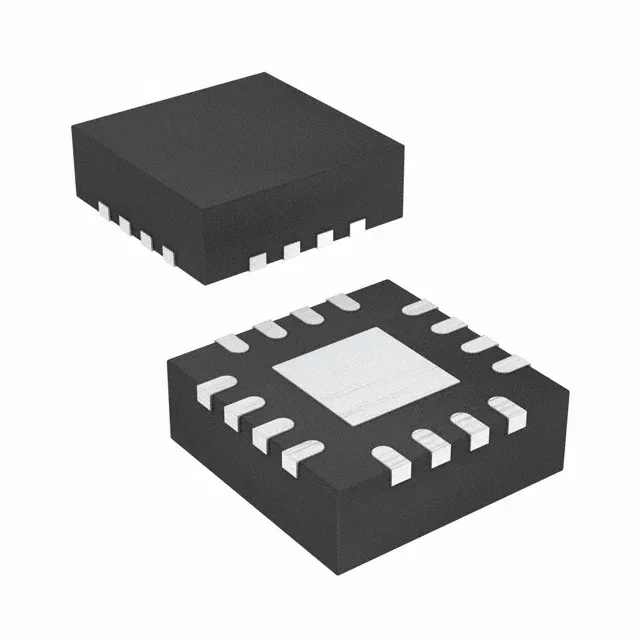
Two amplifiers in a single 16-VQFN with exposed pad saves about 40% board area compared to two SOT-23-5 packages. The 4×4 mm footprint is small enough for dense line-card layouts but still hand-solderable with a fine-tip iron and flux — no hot-air station required if you are careful. The exposed pad must be soldered to a thermal land on the PCB — without it, the junction temperature rises quickly under the 700 mA output condition. The datasheet layout recommendation calls for a 4×4 mm pad with thermal vias to an inner ground plane. Supply span runs from 7 V to 13 V — typically a single +12 V rail or split ±5 V to ±6 V. The 32 mA per channel quiescent adds up to 64 mA for both channels; factor that into the rail's load budget before the output stage.
Industrial temp range — outdoor and base-station ready
Rated -40°C to 85°C ambient, the OPA2673IRGVT fits into outdoor telecom cabinets, base-station RF front-ends, and industrial video distribution amps that see seasonal temperature swings. No AEC-Q100 grade, so it is not qualified for under-hood automotive — but fine for most fixed-infrastructure roles. Input offset voltage is 2 mV typical — acceptable for AC-coupled signal paths like xDSL or video where DC accuracy is not critical. The 6 µA input bias current is a consequence of the current-feedback input stage; it matters if you DC-couple into a high-impedance source.