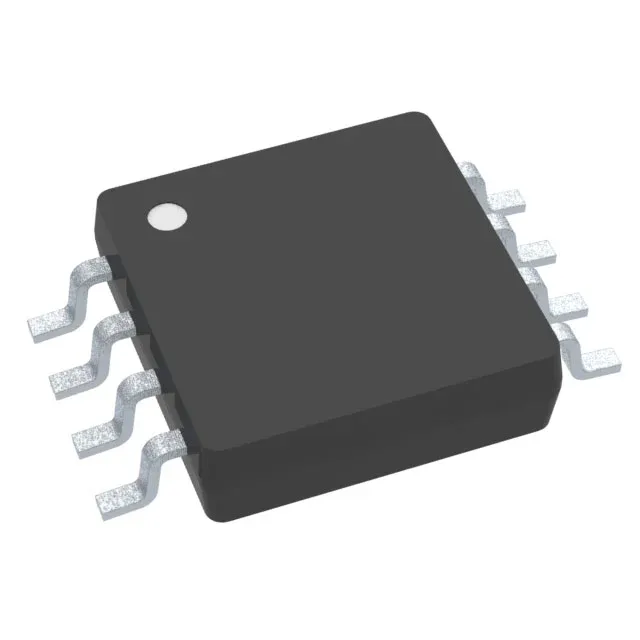
Zero-drift precision for automotive sensor chains
The OPA2388QDGKRQ1: AEC-Q100 Grade 1 qualification covers the -40°C to 125°C ambient range — the full under-hood temperature band for engine-bay or transmission-mounted sensor interfaces. The zero-drift architecture holds input offset voltage to 0.25 µV typical, so a thermocouple or shunt-resistor signal sees no thermally induced drift across the operating range. With 10 MHz gain-bandwidth and a 5 V/µs slew rate, this dual op-amp handles fast sensor outputs like resolver feedback or high-side current-sense transients without slew-rate limiting. The rail-to-rail output swings within 50 mV of the supply rails, preserving dynamic range on a 2.5 V to 5.5 V single supply.
Package and supply integration
The 8-VSSOP package (3.00 mm × 3.00 mm, 0.65 mm pitch) fits tight PCB layouts common in automotive ECU modules. The dual-channel configuration draws 1.9 mA per channel quiescent current — low enough to keep thermal rise negligible in a sealed enclosure. Supply span from 2.5 V to 5.5 V means the same part works on a 3.3 V sensor rail or a 5 V ADC reference rail without a separate regulator. Output drive capability of 60 mA per channel can directly bias a downstream comparator or a small relay coil.
Input bias and noise floor
Input bias current is 30 pA typical — negligible for a 10 kΩ source impedance but worth derating for a 1 MΩ piezoelectric sensor where the bias current times the source resistance produces a voltage error comparable to the offset.